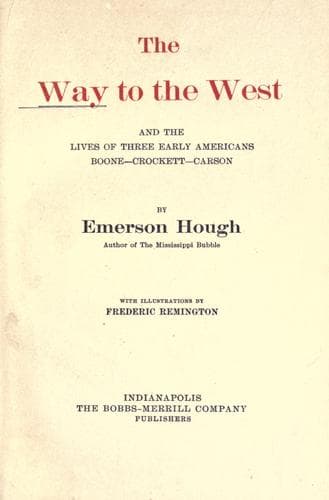
The Way to the West, and the Lives of Three Early Americans: Boone—Crockett—CarsonHough, Emerson
History
The Way to the West, and the Lives of Three Early Americans: Boone—Crockett—Carson
Hough, Emerson
Boone, Daniel, 1734-1820; Carson Kit, 1809-1868; Crockett, Davy, 1786-1836; Mississippi River Valley -- History; West (U.S.) -- History
In 1826 arose one Philip Evans Thomas, sometime known as the father of
American railroads, son of a Baltimore banker, and living, as we may
thus notice as a curious fact, near to that early abiding-place of the
star that marked the center of American population, that Ararat from
which the Western civilization started outward. Early in his life Philip
Evans Thomas saw how excellent it would be if only water could be made
to run up-stream. He had seen the use of railroads in England, and had,
moreover, noted the beneficial effects upon the trade of Eastern cities
of the traffic that was carried by canals. He had the far-reaching mind
of the world-merchant, whose problem is ever that of transportation. He
saw that railroads can go where canals can not, and he presently
resigned his directorship in the Maryland Canal, because he saw that a
canal can not climb a hill, and that mankind could not forever go around
the hills or up and down the streams.
It was on February twelfth, 1827, that Thomas called together
twenty-five of the leading citizens of Baltimore. Comment of the time
says that he seemed touched with the spirit of prophecy as he spoke of
the enterprise that was to cast aside the mountains, to unite the
streams, and to discover what there might be in that mysterious land,
the West—the West that was west of the Alleghanies and in or near the
Mississippi valley. Beyond the Mississippi, of course, the mind of man
might not go! The minutes of this notable railway meeting are preserved
in a pamphlet known as “Proceedings of Sundry Citizens of Baltimore,
convened for the Purpose of Devising the Most Efficient Means of
Improving Intercourse between Baltimore and the Western States.”
There were two opinions as to the wisdom of Mr. Thomas’s project, and
these were the opinions of the North and of the South; for again the
South was to be the pioneer into the West, and again the North was to
follow. The cities of the North made loud outcry against the Baltimore
prophet, and said that this railroad, if built, would divert from them
forever the traffic that was then coming to them from the West. This was
ever the typical attitude of the upper East toward the West.
None the less the enterprise went on, and the Baltimore and Ohio
Railroad Company was duly organized, an act for its incorporation being
passed on February twenty-seventh, 1827. The stamp of success was upon
the idea before the ink had dried on the records. By April twenty-fourth
of the same year stock was subscribed to the figure of four million one
hundred and seventy-eight thousand dollars. The first railway planned
for the West—planned because there was a West and because that West was
wanted as a part of the East—was promptly elevated into one of the most
important commercial enterprises of the time. The stock was coveted by
all, and the struggle was for first place in the line of purchasers.
Public-domain text, read in full here on John Shaqi.
Reviews
Reviews
No reviews yet
Be the first to share your thoughts on this work.
Elsewhere in the archive
Join the Discussion
Join the discussion
Sign in to leave a comment or review.
Sign InorCreate an account