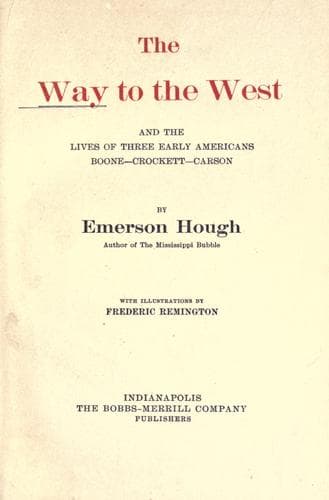
The Way to the West, and the Lives of Three Early Americans: Boone—Crockett—CarsonHough, Emerson
History
The Way to the West, and the Lives of Three Early Americans: Boone—Crockett—Carson
Hough, Emerson
Boone, Daniel, 1734-1820; Carson Kit, 1809-1868; Crockett, Davy, 1786-1836; Mississippi River Valley -- History; West (U.S.) -- History
It can not be within the present purpose to particularize as to the
railroad development of the West, nor to attempt the unimportant
chronological record of first one and then another of the multiplying
railways that early began to crowd out into the West from the Eastern
centers. The important thing is the tremendous expansion of population
that now ensued for the Western states, the blackening of the census
maps in spaces once barren, the crossing and interweaving of the
Northern and Southern populations, which now occurred as both sections
pressed out into the West. There were grandfathers in Virginia now,
grandfathers in New England. The subdivided farms were not so large.
There were more shops in the villages. There was demand for expansion of
the commerce of that day. The little products must find their market,
and that market might still be American. The raw stuff might still be
American, the producer of it might still be American. So these busy,
thrifty, ambitious men came up and stood back of the vanguard that held
the flexible frontier. Silently men stole out yet farther into what West
there was left; but they always looked back over the shoulder at this
new thing that had come upon the land.
Thinking men knew, half a century ago, that there must be an iron way
across the United States, though they knew this only in general terms,
and were only guessing at the changes that such a road must bring to the
country at large. Some of these guesses make interesting reading to-day.
Thus, in 1855 it was announced as a settled thing that the continental
route could not lie across the Northern Rockies, because in that region
the heavy snowfall would block all railway travel. It was concluded that
there were only four points on the Pacific coast to which the railway
might address itself: San Diego, San Francisco, “some spot to be chosen
on the navigable waters of the Columbia,” and another “on the borders of
the Strait of De Fuca, in the new Territory of Washington.”
The government of the country was so slow in developing this railway
project that some capitalists were for building at once a road of their
own, and they chose the route from Charleston to San Diego. What would
it have meant to this country had this been the first and only railway
across the continent? As to the route up the Platte valley and over the
mid-Rockies, that was dismissed as quite impracticable. “The absence of
timber on most of this route would prove an insuperable objection to its
selection, even were it not ineligible from other considerations,”
comments one writer of the day. The same writer[51] says that the route
from San Francisco to St. Louis would be geographically preferable, but
admits that the “formation of the intermediate country, and the
character of the mountain-ranges to be crossed, are deemed to present
insuperable difficulties to its construction.”
Public-domain text, read in full here on John Shaqi.
Reviews
Reviews
No reviews yet
Be the first to share your thoughts on this work.
Elsewhere in the archive
Join the Discussion
Join the discussion
Sign in to leave a comment or review.
Sign InorCreate an account