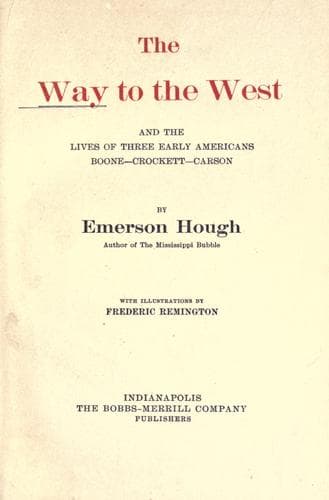
The Way to the West, and the Lives of Three Early Americans: Boone—Crockett—CarsonHough, Emerson
History
The Way to the West, and the Lives of Three Early Americans: Boone—Crockett—Carson
Hough, Emerson
Boone, Daniel, 1734-1820; Carson Kit, 1809-1868; Crockett, Davy, 1786-1836; Mississippi River Valley -- History; West (U.S.) -- History
The bearing of these reflections upon the purpose in hand is not so much
one of mere literary curiousness as one of commercial comparison. The
logic of that time carried a large non sequitur. “The country
intervening between the most western limits of civilization and the
recently settled territories of the Pacific,” says the same early
historian, “is confessedly little known.” The empire of the Middle West
was not dreamed of. This is what the new road was to do:
“Instead of weary months of travel around the capes of Africa and South
America, less than a month will suffice to transport the teas and silks
of China, the coffee and the spices of Java and Ceylon, to the great
Atlantic cities, thence to be distributed as from the world’s depot to
the nations of Europe. But not only will this new mode of transit take
to itself the best and most remunerative part of the traffic now
existing between eastern Asia and Christendom, but it will also create a
new traffic, compared with which the trade now existing will bear almost
no comparison.
“Instead of here and there a seaport in China holding commercial
relations with America, this nearness of access to the best markets of
the world will stimulate into an unprecedented activity the raising of
all agricultural products, the manufacture of all goods and wares, and
the disinterring of all the mineral resources which the three hundred
millions of China can furnish us, at a cheaper rate than we can obtain
them elsewhere. Japan, with a population almost double our own, now shut
out from all intercourse with the rest of the world, must soon be forced
by the strength of circumstances to welcome to her ports the merchant
fleets of other nations, anxious and eager to distribute to the wide
world the rich products of her soil, her climate, and her domestic
industry. The tropical fruitfulness of the over-populated islands of the
Eastern Archipelago will also pour, in increased abundance, the rich
spices of their balmy breezes through this new and rapid conduit.”
Not so bad was this flowery prophecy, though its fulfilment was to run
over into another century, and to fall subsequent to a still greater
industrial phenomenon, the gourd-like maturing of the trans-Missouri
region.[52] This rapid development of the interior region of America was
not foreseen by the wisest of the prophets of fifty years ago. Yet
unspeakably swift and startling as it has been, it was, after all, the
product of an arrested growth, of an advancement upon lines
substantially different from those on which it was originally and
naturally projected.
Public-domain text, read in full here on John Shaqi.
Reviews
Reviews
No reviews yet
Be the first to share your thoughts on this work.
Elsewhere in the archive
Join the Discussion
Join the discussion
Sign in to leave a comment or review.
Sign InorCreate an account