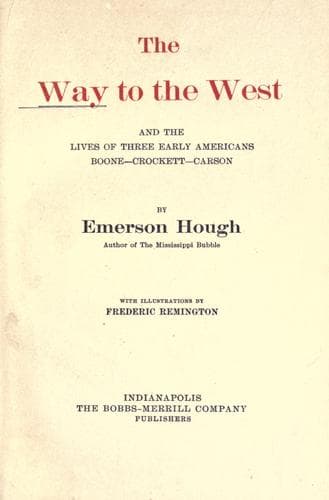
The Way to the West, and the Lives of Three Early Americans: Boone—Crockett—CarsonHough, Emerson
History
The Way to the West, and the Lives of Three Early Americans: Boone—Crockett—Carson
Hough, Emerson
Boone, Daniel, 1734-1820; Carson Kit, 1809-1868; Crockett, Davy, 1786-1836; Mississippi River Valley -- History; West (U.S.) -- History
One railroad recently planned for a Western extension, and laid out
along its lines the sites of thirty-eight new towns, each of which was
located and named before the question of inhabitants for the towns was
ever taken up. Another railway in the Southwest has named fifty cities
that are yet to build; and still others have scores of communities that
in time are to be the battle-grounds of human lives, the stages of the
human tragedy or comedy. The railways have not only reached but created
provinces; they have not only nourished but conceived communities. Out
of that cold upper land of the Northwest, which was thus fostered and
nurtured into strength, there came, in one year, one hundred and ten
million bushels of wheat to feed the world, and that in a year when the
crop shortage was over one hundred million bushels. This is only a part
of the output of that land, for the railway showed these farmers long
ago that diversified farming was their hope and their salvation.
Past one of those forts which in 1812 the United States erected to
protect her fur traders and to keep out her covetous rivals, there came
in the same year from the far Northwest, once home of the buffalo, the
Indian, and the scout, twenty-five million two hundred fifty-five
thousand eight hundred and ten tons of freight, nearly all of the
long-haul sort, and hence to be taken as showing in part the product of
the far Northwest itself. Three transcontinental roads, the Northern
Pacific, the Union Pacific, and the Southern Pacific, in 1899 carried
twenty million one hundred forty-six thousand four hundred and ten tons
of freight, with a haul averaging about three hundred miles in length.
Nearly a thousand millions of dollars is represented in the
capitalization of these roads—far more than is demanded by the free
roadway of the Great Lakes, the modern freight traffic of which is
really a development subsequent to that of the railway exploitation of
the West. This perhaps suggests a day when Chicago may come to be as
closely connected with New Orleans as was the latter city with Kentucky
in the day of Wilkinson.[57] It is impossible to study the industrial
history of the West without studying also that of the South, for though
the two sections are far apart and utterly unlike, they yet have the
intercurrent soul of twins. No part of America is less known and more
misunderstood than the South, and surely it must be one of the most
cheering reflections to conclude that yearly the South comes closer to
the North, and the North to the South. Statesmanship could not in a
century so fully have accomplished this great and desirable result. The
railroads are doing what statecraft could not do.
Public-domain text, read in full here on John Shaqi.
Reviews
Reviews
No reviews yet
Be the first to share your thoughts on this work.
Elsewhere in the archive
Join the Discussion
Join the discussion
Sign in to leave a comment or review.
Sign InorCreate an account