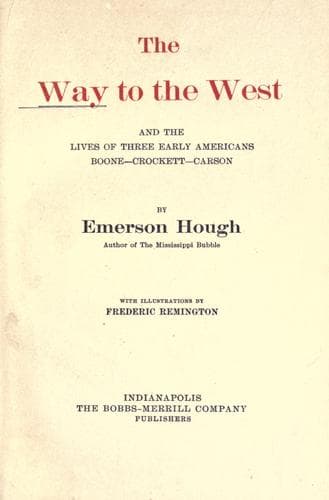
The Way to the West, and the Lives of Three Early Americans: Boone—Crockett—CarsonHough, Emerson
History
The Way to the West, and the Lives of Three Early Americans: Boone—Crockett—Carson
Hough, Emerson
Boone, Daniel, 1734-1820; Carson Kit, 1809-1868; Crockett, Davy, 1786-1836; Mississippi River Valley -- History; West (U.S.) -- History
It is the part of the great captains of transportation to live strenuous
lives, to work out great problems faithfully and patiently, to
accomplish great results mysteriously, to live, to die, and to be
forgotten. The heroes of the hustings, the heroes of our wars, are
remembered and immortalized. The man that makes possible their triumphs
finds no record on the page of time. His obituary is only the passing
chronicle of the daily press, feverishly concerned with what is known as
news.
To-day James F. Joy, the father of the Michigan Central Railroad, is
little known by the general public, though his was a far greater work
than that of seeking public office. John Murray Forbes, father of the
great Burlington and Quincy system, is a man too much forgotten. As
these lines are written comes the news of the death of Henry Villard,
the man that solved so many problems for the Northern Pacific. Dropped
for the time out of sight, he will now shortly follow the fate of his
compeers, and soon be dropped forever. William Henry Osborn died only a
few years ago, yet there are many who make the winter trip to the Gulf
coast that do not know who planned the flight of rails that runs from
the Great Lakes to the Gulf. It is a duty and a pleasure to mention the
names of such great and useful men, if only to ask that their work be
held in understanding memory.
Especially significant now is the memory of Mr. Osborn, and we might
well speak of him as assistant and coadjutor of such men as Lincoln and
Grant, and the statesmen who since the war have sought to unite North
and South. As we find that it was the South that first marched westward,
and a Southern man who first planned a great highway of iron into the
West, we may state with equal pleasure and confidence that it was the
East, and an Eastern man, that made the South a portion of the West, and
both a part of a united America.
William H. Osborn was a native of Massachusetts, and was by birth of no
exalted position in the world. His chief capital was a clear brain and
an unclouded purpose, which later ripened into a farsightedness in large
affairs that has rarely been equaled in the ranks of practical American
men. Sent to the East Indies as the representative of a New York firm,
he got a good insight into the trade in spices, and was successful in
its operation. Later he married the second daughter of that sterling
American merchant, Jonathan Sturges of New York, whose first daughter
was the first wife of J. Pierpont Morgan. Mr. Sturges was heavily
interested in the young Illinois Central Railroad, the first of the
land-grant railways, the original seven hundred and five miles of which
were intended to develop the agricultural lands of the great prairie
state of Illinois, and to bear the products of that state up to the
water-transport of the Great Lakes, which then carried most of the
long-haul business from the West to the East.
Public-domain text, read in full here on John Shaqi.
Reviews
Reviews
No reviews yet
Be the first to share your thoughts on this work.
Elsewhere in the archive
Join the Discussion
Join the discussion
Sign in to leave a comment or review.
Sign InorCreate an account