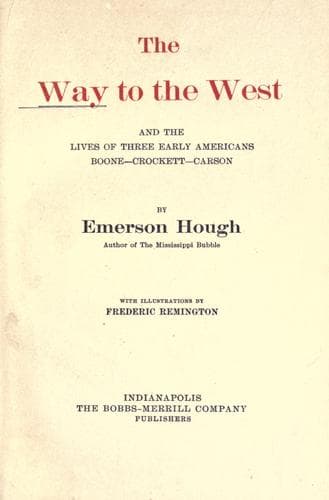
The Way to the West, and the Lives of Three Early Americans: Boone—Crockett—CarsonHough, Emerson
History
The Way to the West, and the Lives of Three Early Americans: Boone—Crockett—Carson
Hough, Emerson
Boone, Daniel, 1734-1820; Carson Kit, 1809-1868; Crockett, Davy, 1786-1836; Mississippi River Valley -- History; West (U.S.) -- History
It is a matter of wonder that any American literature could ever speak
of the American West in anything but terms of pride and honor. There is
a certain literature, color-crammed, superficial, and transient, because
wrong, that affects to believe that there is still a West that is a land
of crude souls exclusively and of little hope for a hereafter. If the
good folk who so believe lack the great privilege of actual American
travel, they have at least left for them the resources of an American
railroad map. Let them study; and even if they study no deeper than the
map, they must come to see that the West is no more as once it was.
Changed unspeakably and utterly, the old West lies in ruins. To pick
about among those ruins may, indeed, be to find here and there a bit of
local color; but were it not better to reflect that this color may be
only the broken bits of a cathedral pane? Restore that cathedral, in
recollection, in imagination at least, if it be within the skill of art
or literature to do so. Restore it, and write upon its arch the thought
that history may be more than a mere recital of wars and religions; that
the destruction of human life may be nationally not so great as the
development of human character. Give the men of the old West, parents of
the men of the new West, this epitaph: They had character. Let the
heroes have place of honor in their own cathedral; and so may the
Western earth lie light above them, and the Western skies smile over
them rememberingly.
-----
Footnote 48:
The Century Magazine, January, 1902.
Footnote 49:
Another instance of changed standards in the West may be seen in the
revolution as to petty prices. Up to twenty years ago, in most Rocky
Mountain communities, the quarter-dollar was the smallest coin in
circulation. With the railroads came the dime, the nickel, and at last
the penny; but they came to a West that was no more.
A Montana periodical thus comments on these matters as they appeared
at the time when the railroad reached Miles City:
“The advent of the Northern Pacific Railroad, in November, 1881,
brought about a complete change in the methods and manners of the
people. The railroad brought the community at once in touch with the
more concise and narrower life of ‘the States’; the ‘nickel’ displaced
the ‘quarter’ as the smallest coin in use, and prices shrunk
accordingly. . . . This proposed innovation was hotly contested for a
while by the adherents of the ‘two-bit’ theory, resulting finally in a
compromise that established ‘two-for-a-quarter’ as the going rate. It
would be hard to describe the feeling of dejection that overwhelmed
the old-timers when this conclusion was reached. It was accepted by
them as a pronounced and evident sign of decadence.”
Footnote 50:
Public-domain text, read in full here on John Shaqi.
Reviews
Reviews
No reviews yet
Be the first to share your thoughts on this work.
Elsewhere in the archive
Join the Discussion
Join the discussion
Sign in to leave a comment or review.
Sign InorCreate an account