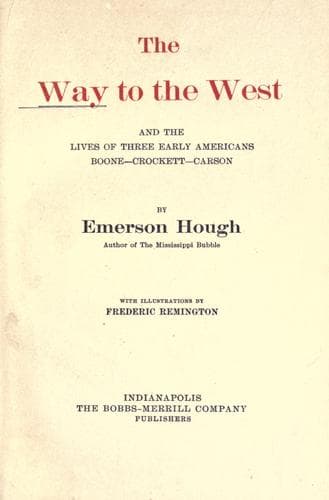
The Way to the West, and the Lives of Three Early Americans: Boone—Crockett—CarsonHough, Emerson
History
The Way to the West, and the Lives of Three Early Americans: Boone—Crockett—Carson
Hough, Emerson
Boone, Daniel, 1734-1820; Carson Kit, 1809-1868; Crockett, Davy, 1786-1836; Mississippi River Valley -- History; West (U.S.) -- History
A settler who moved, in 1854, from Virginia to Iowa complained that
for a whole year in that frontier country he saw no fruit except a
half-peck of crab-apples. It was much the same in Minnesota at that
time; yet, in the year 1900, the city of St. Paul alone used one
thousand dollars’ worth or grapes each day for fifty days, all
imported, and at an average price of only fifteen cents per basket.
This fruit was largely imported from the state of New York.
Footnote 51:
Henry Howe; “The Great West” (1855).
Footnote 52:
In the year 1900 began the great tendency toward consolidation in
railway interests. Nor did the sequence cease at this point. In the
same year there were begun, for use upon the Pacific Ocean in
connection with this same transcontinental route, five giant
ocean-going freight ships, the largest yet known, each to be 750 feet
in length, of 74 feet beam, and with a carrying capacity of 22,000
tons. These ships will carry American cotton to Japan, for use instead
of the short-staple cotton of India, until recently used by Japan.
They will enable the railroad-builders of Japan to figure as exactly
on the price of a ton of rails as can the contractor of Kansas or
Nebraska. They will lay down a barrel of Minnesota flour in China or
the Philippines at a cost for carriage of not over $1.25. All this
shows to what extent American commerce, made active by American
transportation methods, is invading the markets of the world; for, at
this same time, Russia can not lay down a barrel of (an inferior)
flour at the seaboard of China for less than $4.25. Surely our prophet
of 1855 dreamed more wisely than he knew!
Footnote 53:
The desecration of America, in the terrible devastation of her
forests, is something no observant man can face with composure.
Footnote 54:
The time is not one for individual optimism, and the old hopefully
self-reliant spirit of the West must be content to lose its personal
quality in the larger and vaguer, though not less certain, tendencies
of modern life. Bearing upon a theme kindred to the above, James
Bryce, author of “The American Commonwealth,” recently found occasion
to write:
Public-domain text, read in full here on John Shaqi.
Reviews
Reviews
No reviews yet
Be the first to share your thoughts on this work.
Elsewhere in the archive
Join the Discussion
Join the discussion
Sign in to leave a comment or review.
Sign InorCreate an account