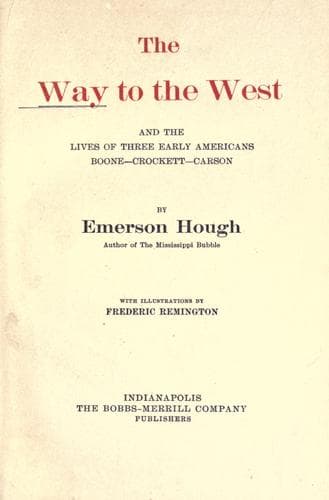
The Way to the West, and the Lives of Three Early Americans: Boone—Crockett—CarsonHough, Emerson
History
The Way to the West, and the Lives of Three Early Americans: Boone—Crockett—Carson
Hough, Emerson
Boone, Daniel, 1734-1820; Carson Kit, 1809-1868; Crockett, Davy, 1786-1836; Mississippi River Valley -- History; West (U.S.) -- History
“National ideals to-day tend toward a large and strong state, with
vast external possessions, with a huge army and navy, with an
extending trade, and great consequent wealth; and the ideal of
education is less toward ‘unprofitable culture’ and more toward
subjects that enable men to raise themselves in the world. People now
talk more about capital and labor. Formerly there seemed rather more
faith in the power of reason, rather more hope of progress to be
secured by political change. Altogether there seemed rather more of a
sanguine spirit formerly. Mankind must never cease to cherish and
follow the dream of that golden age, which at one time they believed
to lie in the past, but which for some centuries had been supposed to
glimmer in the future. They must never forget that hope. But the
golden age seemed nearer in 1850 than it does now.”
Footnote 55:
The late Cushman K. Davis, United States senator from Minnesota.
Footnote 56:
In 1902 Canada began to emulate the history of the United States, and
planned for the building of two more transcontinental railways. She
could inflict no greater blow to the United States. V. also Chap. V,
Vol. IV; “The Pathways of the Future.”
Footnote 57:
Engineers disagree as to the possibility of making a ship-canal of the
great highway of the Mississippi; but engineers have always disagreed
about the doing of great things, and then have always done them. It is
likely that the dream of that shrewd merchant-explorer, Louis Joliet,
will eventually be realized, and the Chicago drainage-canal will in
that case attain a great importance.
Indeed, inland-water transportation may be upon the eve of a great
development. Thus, in December, 1900, there was organized a canal
company for the purpose of navigating the Red River of the North, of
improving the channel by dredging, putting in locks and reservoirs, to
regulate that historic stream into conditions virtually those of a
canal. Another curious proposition to reach Congress in the same year
was a bill for the purpose of building a ship-canal between Lake Erie
and the Ohio River, an enterprise which would have great significance
in the coal and iron trade. This canal would follow the course of La
Salle on his first journey from the Great Lakes—the old south-bound
war-trail of the Six Nations. Geography, of all things, seems to
repeat itself. No one may tell what new importance this canal
proposition may attain, though it may be dormant for a time.
Early in the year 1901 the leading journals of Germany were discussing
the prospects of a canal from Chicago to the Atlantic Ocean, and held
the enterprise practicable.
Public-domain text, read in full here on John Shaqi.
Reviews
Reviews
No reviews yet
Be the first to share your thoughts on this work.
Elsewhere in the archive
Join the Discussion
Join the discussion
Sign in to leave a comment or review.
Sign InorCreate an account