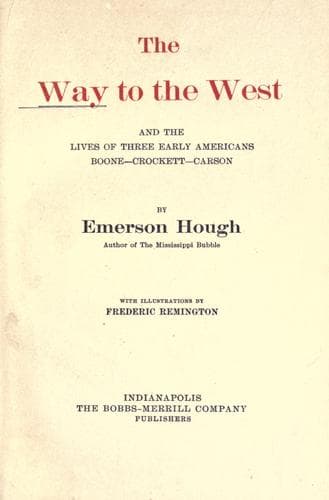
The Way to the West, and the Lives of Three Early Americans: Boone—Crockett—CarsonHough, Emerson
History
The Way to the West, and the Lives of Three Early Americans: Boone—Crockett—Carson
Hough, Emerson
Boone, Daniel, 1734-1820; Carson Kit, 1809-1868; Crockett, Davy, 1786-1836; Mississippi River Valley -- History; West (U.S.) -- History
As showing the extent of water-transportation on our Great Lakes, it
may be stated that more tonnage passes Sault Ste. Marie in seven
months of each year than goes through the Suez Canal in three years.
The city of Duluth alone, at the head of the water-trail, has a
tonnage each year of more than 11,500,000 tons.
Footnote 58:
The population of Michigan in the decade 1890-1900 drifted rapidly
toward the cities. Yet the Michigan railroads are bravely trying to
solve the problem of building up a population on the country desolated
by the lumbermen, and with great success are developing resources in
agriculture and manufactures which for a long time lay unsuspected.
Footnote 59:
In this connection the census map offers an unfailing interest.
Investigation shows that our star, denoting the center of population,
has traveled in all only 525 miles since 1790, the greatest west-bound
gains being in the decade 1850-60, 81 miles. At no time has the center
of population moved back toward the East, though it is nearer to doing
so now than ever before—proof that the history of America has been
but the history of a West, and also proof that that wayward West may
soon bend its footsteps homeward after a century of adventure. The
record of the movement of the population center is as follows:
1790, 23 miles east of Baltimore, Maryland; 1800, 18 miles west of
Baltimore, Maryland; 1810, 40 miles northwest by west of Washington,
D. C.; 1820, 16 miles north of Woodstock, Virginia; 1830, 19 miles
west-southwest of Moorefield, West Virginia; 1840, 16 miles south of
Clarksburg, West Virginia; 1850, 23 miles southeast of Parkersburg,
West Virginia; 1860, 20 miles south of Chillicothe, Ohio; 1870, 48
miles east by north of Cincinnati, Ohio; 1880, 8 miles west by south
of Cincinnati, Ohio; 1890, 20 miles east of Columbus, Indiana; 1900, 7
miles north of Columbus, Indiana.
------------------------------------------------------------------------
ACROSS THE PACIFIC
CHAPTER I
THE IRON TRAILS
At the time of the discovery of gold in California, there had been built
up a splendid Western population, hardy, self-confident, able to shift
for itself, wholly distinct from that population that it had for a
generation left behind at the old starting places of the trails. These
trails across the continent, wavering, tortuous, yet practicable, had
been fully established. So far as might be within the horizon of those
days, all was now ready for the epoch-making event that was to change
all the methods of America, that was to make Westerners by wholesale and
to draw them swiftly from every corner of the earth.
Public-domain text, read in full here on John Shaqi.
Reviews
Reviews
No reviews yet
Be the first to share your thoughts on this work.
Elsewhere in the archive
Join the Discussion
Join the discussion
Sign in to leave a comment or review.
Sign InorCreate an account