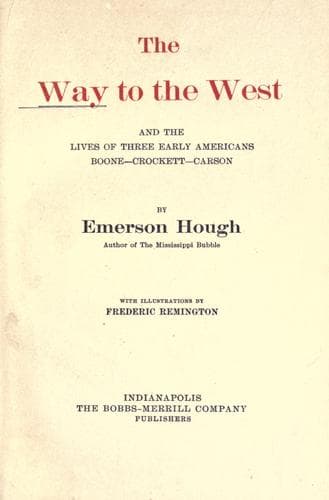
The Way to the West, and the Lives of Three Early Americans: Boone—Crockett—CarsonHough, Emerson
History
The Way to the West, and the Lives of Three Early Americans: Boone—Crockett—Carson
Hough, Emerson
Boone, Daniel, 1734-1820; Carson Kit, 1809-1868; Crockett, Davy, 1786-1836; Mississippi River Valley -- History; West (U.S.) -- History
The great state of California alone was cause and sufficient reason for
the swift development of the remoter American West. There can not be
denied the tremendous effect produced by the sudden growth of
California, coming as it did hard on the time of the annexation of Texas
and the widening of our national territory in the far Southwest. As to
the discovery of gold and the swift growth of California being unmixed
benefits, there may exist at this later day something of a sober doubt.
California marked the beginning of the feverish, insane, excitable type
of American, who wishes to do everything at once—and does it! Without
California and the Civil War we should to-day still be settling the
West. With California we are settling the islands of the Orient. The
high-geared life of to-day is part of the corollary of washing a year’s
income out of the ground in an hour’s work, of crossing the continent in
a week instead of a season, of tearing down mountains by machinery
instead of building up homesteads deliberately. Stimulation and
destruction do not go so far apart. California gave to the world the
spectacle of a nation drunk with energy, using with maddened zeal for a
time powers made three-fold, employing an imagination under whose
concept naught under Heaven seemed impossible—or was impossible!
This was revolution. There was a demand for revolution of an even pace
in all lines of allied industry. It was time for the railroad, and the
railroad must now perforce come swiftly. We built better steamships to
get out into our new, feverish, golden West. We used the old trails, but
they would no longer serve. We employed the old mountain passes, the old
grazing and watering places, but neither would these serve. No time now
for hoof or wheel, or for the way of the ship upon the sea! No time now
for the wayside ranches along the Platte, for the old posts of Laramie
and Bridger and Hall! The golden country clamored all too strongly.
Therefore, with a leap, the old trails straightened out and shortened.
New passes over the Great Divide were found. The long thin line of rails
connected the East with a West now swiftly grown mightier than itself.
All American morals and manners underwent swift reconstruction. The
United States, plus California, plus the Western railways, became a
different nation.
It is not necessary to take up in detail the chronological or
geographical study of the building of the transcontinental railways.
They have done their work. The commercial history of America is
sufficiently well written to-day on the face of every country of the
globe. We have built our own railroads, and to-day we build and sell
railroads and equipment for the Himalayas and the Sudan. We shall build
the railroads that will make Africa another America. We shall build the
railroads that will at length bring the Anglo-Saxon face to face with
the Slav, in that struggle that shall pit the American West against the
Russian East.
Public-domain text, read in full here on John Shaqi.
Reviews
Reviews
No reviews yet
Be the first to share your thoughts on this work.
Elsewhere in the archive
Join the Discussion
Join the discussion
Sign in to leave a comment or review.
Sign InorCreate an account