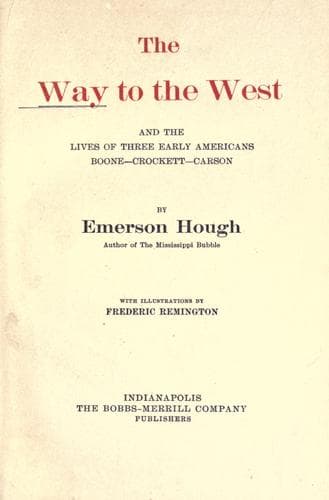
The Way to the West, and the Lives of Three Early Americans: Boone—Crockett—CarsonHough, Emerson
History
The Way to the West, and the Lives of Three Early Americans: Boone—Crockett—Carson
Hough, Emerson
Boone, Daniel, 1734-1820; Carson Kit, 1809-1868; Crockett, Davy, 1786-1836; Mississippi River Valley -- History; West (U.S.) -- History
Recently there was erected at Doylestown, Pennsylvania, a monument to a
forgotten man, John Fitch, who in the year 1785 was known as one curious
in experiments with steam as a motive power. Fitch built a steamboat,
and had visions of many things in the way of steam locomotion. The life
of this unknown man marks the extent of our backward vision in these
matters; yet Fitch lived little more than a century ago. Indeed, the
growth of the railroads of America has taken place in less than
three-quarters of a century. And yet to-day we have more than two
hundred thousand miles of railway, and as each day rolls by, we build
from ten to twenty-five miles more. Railroading is a profession
perfected in the hard evolution of American necessity. Our first
railways were but attempts, guesses, desires, hopes, purely local
propositions and not always well conceived as such. Yet they grew and
multiplied, and presently, before we had time to think, they had
multiplied over much. Then came the days of the railroad receiver. After
the receiver there came the combiner. This man, in these bubble days of
so-called prosperity, for a time undertakes to do what competition was
not able to do. It is only for a time that any man or combination of men
can escape the workings of the great natural law of competition. Neither
monopolies nor trades-unions, neither the “trust” in capital nor the
“trust” in labor can forever evade it. In time there will again be
change; and meantime, ruin.
To-day there are five great centralizations or combinations of capital
that control the railway situation in America. In these swift times of
change these arrangements may not long remain permanent, and it is
bootless to mention them specifically. The building of these thousands
of miles of railway and the assembling of them together under industrial
truce has been the product of a giant game in commerce, a commerce not
to be confined wholly by the limits of this continent. The great ships
built for the Orient are now an old story, an accepted enterprise that
spells Europe on the one hand and Asia on the other.
Public-domain text, read in full here on John Shaqi.
Reviews
Reviews
No reviews yet
Be the first to share your thoughts on this work.
Elsewhere in the archive
Join the Discussion
Join the discussion
Sign in to leave a comment or review.
Sign InorCreate an account