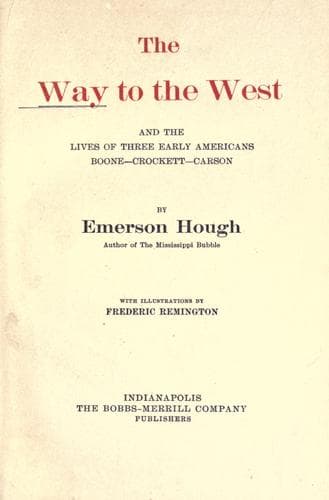
The Way to the West, and the Lives of Three Early Americans: Boone—Crockett—CarsonHough, Emerson
History
The Way to the West, and the Lives of Three Early Americans: Boone—Crockett—Carson
Hough, Emerson
Boone, Daniel, 1734-1820; Carson Kit, 1809-1868; Crockett, Davy, 1786-1836; Mississippi River Valley -- History; West (U.S.) -- History
As for our own marches, Alaska is to repeat at least in part the story
of California. The Yukon and White Pass Railway is but a hint, a
beginning. It is now upon the question of a railway from Circle City in
Alaska to the Bering Sea, to connect there with a railway which shall
eventually tap both China and Siberia! It is entirely within possibility
that we shall in time see a continuous railway transportation from the
Atlantic to the far-off straits that separate this country from Asia.
Scientists tell us that over these straits there perhaps came once the
ancestors of the aboriginal population of this continent. This
population we have destroyed. There will also be destroyed all those
nomad tribes of northeastern Asia that seem not useful in this great
scheme which we call civilization. Alaska was long thought uninviting;
yet railroad building there is feasible, and Alaska is feasible as
residence for man; and railroad man is concerned with every corner of
this globe that can serve as residence for human beings.
In the course of an address during the year 1901, a modern railway
man[60] spoke in part as follows: “The twentieth century has been
ushered into existence, and at its very dawn we find a struggle, not for
the acquisition of new territory, not for the subjection of foreign
countries, not a crusade to introduce a new and better religion, but a
struggle between the great nations of the earth for supremacy in
industrial pursuits and to supply the markets of the world. The
nineteenth century has frequently been referred to as the Age of
Transportation. Distribution is the handmaid of production. Bacon said:
‘There are three things that make a country great: fertile fields, busy
workshops, easy conveyance for men and goods from place to place.’ The
evolution that has taken place in the transportation of this country
during the nineteenth century has been remarkable and unparalleled in
the history of man. In the year 1800 it cost one hundred dollars to move
a ton of wheat from Buffalo to New York. The regular rate is now a
dollar and a half per ton, and it has been carried for a dollar. One
hundred years ago we paid twenty-five cents per mile, traveling by
stage-coach, without baggage; now we carry home-seekers from the East
into California for approximately one-twentieth of the old rate.
Public-domain text, read in full here on John Shaqi.
Reviews
Reviews
No reviews yet
Be the first to share your thoughts on this work.
Elsewhere in the archive
Join the Discussion
Join the discussion
Sign in to leave a comment or review.
Sign InorCreate an account