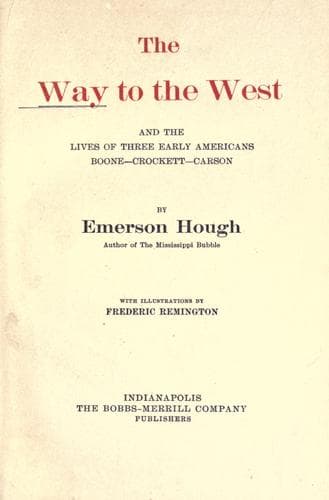
The Way to the West, and the Lives of Three Early Americans: Boone—Crockett—CarsonHough, Emerson
History
The Way to the West, and the Lives of Three Early Americans: Boone—Crockett—Carson
Hough, Emerson
Boone, Daniel, 1734-1820; Carson Kit, 1809-1868; Crockett, Davy, 1786-1836; Mississippi River Valley -- History; West (U.S.) -- History
The boat party had many hundreds of miles of unknown and dangerous
waters to travel, and the journey took them three months, a time longer
than it now requires to travel around the world. They ran thirty miles
of rapids on the shoals of the Tennessee, pursued and fired upon by
Cherokees. Of this division of the party only ninety-seven got through
alive, and nine of these were wounded. One was drowned, one died of
natural causes and was buried, and the rest were killed by the Indians.
[Illustration: THE DOWN-RIVER MEN.]
Their voyage was indeed “without a parallel in modern history.” Among
those who survived the hardships of the journey was Rachel Donelson,
later the wife of Andrew Jackson.
The path of empire in America, the path of corn and venison, was a
highway that never ran backward. These men would never leave this
country now that they had taken it. But what a tax was this that the
barbaric land demanded of them! In November of 1780, less than a year
after the party was first organized, there were only one hundred and
thirty-four persons left alive out of the original three hundred and
eighty, but in the settlement itself there had not been a natural death.
The Indians killed these settlers, and the settlers killed the Indians.
Death and wounds meant nothing to the adults. The very infants learned a
stoic hardihood. Out of two hundred and fifty-six survivors, thirty-nine
were killed in sixty days. Out of two hundred and seventeen survivors,
the next season saw but one hundred and thirty-four left.
The spring of 1781 found only seventy persons left alive. But when the
vote was cast whether to stay or return, not one man voted to give up
the fight. In that West corn was worth one hundred and sixty-five
dollars a bushel, and in its raising the rifle was as essential as the
plow. Powder and lead were priceless. Man and woman together, fearless,
changeless, they held the land, giving back not one inch of the
west-bound distance they had gained!
In 1791 there were only fifteen persons left alive out of the three
hundred and eighty that made this American migration. There had been
only one natural death among them. In such a settlement there was no
such thing as a hero, because all were heroes. Each man was a master of
weapons, and incapable of fear. No fiction ever painted a hero like to
any one of these. One man, after having been shot and stabbed many
times, was scalped alive, and jested at it. A little girl was scalped
alive, and lived to forget it. An army of Indians assaulted the
settlement, and fifteen men and thirty women beat them off. Mrs. Sally
Buchanan, a forgotten heroine, molded bullets all one night during an
Indian attack, and on the next morning gave birth to a son.
Public-domain text, read in full here on John Shaqi.
Reviews
Reviews
No reviews yet
Be the first to share your thoughts on this work.
Join the Discussion
Join the discussion
Sign in to leave a comment or review.
Sign InorCreate an account