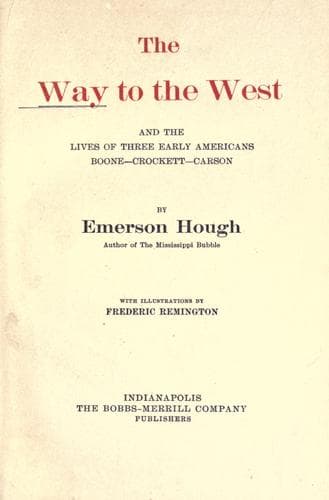
The Way to the West, and the Lives of Three Early Americans: Boone—Crockett—CarsonHough, Emerson
History
The Way to the West, and the Lives of Three Early Americans: Boone—Crockett—Carson
Hough, Emerson
Boone, Daniel, 1734-1820; Carson Kit, 1809-1868; Crockett, Davy, 1786-1836; Mississippi River Valley -- History; West (U.S.) -- History
In time this early outbound man learned that there were rivers that ran,
not to the southwest and into the sea, but outward, beyond the mountains
and toward the setting sun. The winding trails of the Alleghanies led
one finally to rivers that ran toward Kentucky, Tennessee, even farther
out into that unknown, tempting land which still was called the West.
Thus it came that the American genius broke entirely away from
salt-water traditions, asked no longer “What cheer?” from the ships that
came from across the seas, clung no longer to the customs, the costumes,
the precedents or standards of the past.
There came the day of buckskin and woolsey, of rifle and ax, of men
curious for adventures, of homes built of logs and slabs, with puncheons
for floors, with little fields about them, and tiny paths that led out
into the immeasurable preserves of the primeval forests. A few things
held intrinsic value at that time—powder, lead, salt, maize, cow-bells,
women that dared. It was a simple but not an ill ancestry, this that
turned away from the sea-coast forever and began the making of another
world. It was the strong-limbed, the bold-hearted that traveled, the
weak that stayed at home.
Thus began the true American aristocracy, the aristocracy of ability.
The dashing Cavalier, your high-churchman from England, was not the
first over the Appalachians. It was the Protestant, the Quaker, the
dissenter, the independent who led the way into another world and into
another order of things.
Of this hardy folk who left home when yet there was no need of so doing,
and who purposed never to come back from the land they were to
discover,—types of that later proverb-making Western man who “came to
stay,”—let us seek out one where there were many, some distant
Phenician, some master of ways and means, some captain of his time. One
man and one community may serve as typical of this epoch.
In 1779 one James Robertson, of the Watauga settlements of North
Carolina, a steadfast man, heard certain voices that called him to the
West. James Robertson, the steadfast, forming his company for this
uncertain, perilous enterprise, said: “We are the advance guard of a
civilization, and our way is across the continent.” Simple words,—yet
that was in 1779!
Now, for the building of this one town, the town that is now the city of
Nashville, and the capital of Tennessee, this leader had gathered three
hundred and eighty persons, men, women, and children. All the women and
children, one hundred and thirty in number, in charge of a few men, went
by boat, scow, pirogue, and canoe, in the winter-time, down the bold
waters of the Holston and Tennessee rivers. The rest traveled as best
they might over the five hundred miles of “trace” across Kentucky. Of
this whole party two hundred and twenty-six got through alive.
Public-domain text, read in full here on John Shaqi.
Reviews
Reviews
No reviews yet
Be the first to share your thoughts on this work.
Join the Discussion
Join the discussion
Sign in to leave a comment or review.
Sign InorCreate an account