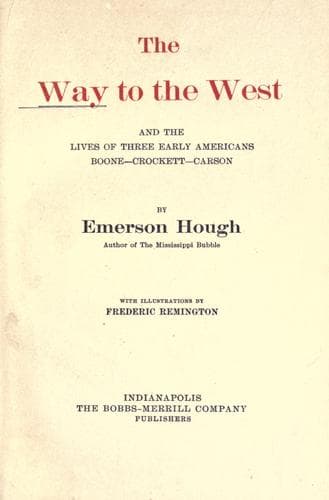
The Way to the West, and the Lives of Three Early Americans: Boone—Crockett—CarsonHough, Emerson
History
The Way to the West, and the Lives of Three Early Americans: Boone—Crockett—Carson
Hough, Emerson
Boone, Daniel, 1734-1820; Carson Kit, 1809-1868; Crockett, Davy, 1786-1836; Mississippi River Valley -- History; West (U.S.) -- History
“We endured almost unconquerable difficulties in settling this Western
country,” they said, “in full confidence that we should be enabled to
send our products to the market through the rivers that water the
country; but we have the mortification not only to be excluded from that
channel of commerce by a foreign nation, but the Indians are rendered
more hostile through the influence of that nation.”
To add to the intricacy of this situation, now came one General James
Wilkinson, late of a quasi-connection with the Continental army, who
early discovered the profit of the trade to the mouth of the
Mississippi. Discovering, likewise, the discontent of the West, which
was almost wholly dependent upon that river for its transportation, he
conceived the pretty idea of handing over this land to Spain, believing
that in the confusion consequent upon such change his own personal
fortunes must necessarily be largely bettered. The archives show the
double dealings of Wilkinson with Spain, Great Britain, and the United
States. He played fast and loose with friend and foe, until at length he
found his own level and met in part his just deserts.
Meantime the stout little government at Washington, knowing well enough
all the dangers that threatened it, continued to work out the problems
crowding upon it. Some breathless, trembling years passed by—years full
of wars and treaties in Europe as well as in America. Then came the end
of all doubts and tremblings. The lying intrigues at the mouth of
America’s great roadway ceased by virtue of that purchase of territory
which gave to America forever this mighty Mississippi, solemn, majestic,
and mysterious stream, perpetual highway, and henceforth to be included
wholly within the borders of the West.
The acquisition of this territory was due not so much to American
statesmanship or foresight as to either the freakishness or wisdom of
Napoleon Bonaparte, then much disturbed by the native revolts in the
West Indies, and harassed by the impending war with England. Whether
England or France would land troops at New Orleans was long a question.
The year that saw the Mississippi made wholly American was one mighty in
the history of America and of the world.
The date of the Louisiana Purchase is significant not more in virtue of
the vast domain added to the West than because of the fact that with
this territory came the means of building it up and holding it together.
It was now that for the first time the solidarity of this New World was
forever assured. We gained a million uninhabited miles—a million miles
of country that will one day support its thousands to the mile. But
still more important, we gained the right and the ability to travel into
it and across it and through it. France had failed to build roads into
that country, and thereafter neither France nor any other foreign power
might ever do so.
Public-domain text, read in full here on John Shaqi.
Reviews
Reviews
No reviews yet
Be the first to share your thoughts on this work.
Join the Discussion
Join the discussion
Sign in to leave a comment or review.
Sign InorCreate an account