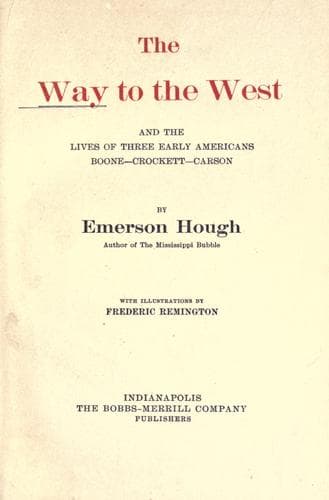
The Way to the West, and the Lives of Three Early Americans: Boone—Crockett—CarsonHough, Emerson
History
The Way to the West, and the Lives of Three Early Americans: Boone—Crockett—Carson
Hough, Emerson
Boone, Daniel, 1734-1820; Carson Kit, 1809-1868; Crockett, Davy, 1786-1836; Mississippi River Valley -- History; West (U.S.) -- History
We who have the advantage of the retrospect understand the Mississippi
and its tributaries far better than did the statesmen of a hundred years
ago. Indeed, it was then the belief of many of the ablest minds that we
ought not to accept this Louisiana Purchase even as a gift. Josiah
Adams, in discussing the bill for the admission of Louisiana as a state,
said: “I am compelled to declare it as my deliberate opinion that if
this bill passes, the bonds of this Union are virtually dissolved; that
the states which compose it are free from their moral obligations; and
that, as it will be the right of all, so it will be the duty of some, to
prepare definitely for a separation, amicably if they can, violently if
they must.”
This from Massachusetts, later to be the home of abolition and of
centralization! It may sit ill with the sons of Massachusetts to reflect
that their own state was the first one deliberately to propose
secession. Still more advanced was the attitude of James White, who
painted the following dismal picture of that West which was to be:
“Louisiana must and will be settled if we hold it, and with the very
population that would otherwise occupy part of our present territory.
Thus our citizens will be removed to the immense distance of two or
three thousand miles from the capital of the Union, where they will
scarcely ever feel the rays of the general government; their affections
will become alienated; they will gradually begin to view us as
strangers; they will form other commercial connections, and our
interests will become distinct. These, with other causes that human
wisdom may not now foresee, will in time effect a separation, and I fear
our bounds will be fixed nearer to our houses than the waters of the
Mississippi. We have already territory enough, and when I contemplate
the evils that may arise to these States from this intended
incorporation of Louisiana into the Union, I would rather see it given
to France, to Spain, or to any other nation of the earth, upon the mere
condition that no citizen of the United States should ever settle within
its limits, than to see the territory sold for a hundred million of
dollars and we retain the sovereignty. . . . And I do say that, under
existing circumstances, even supposing that this extent of territory was
a valuable acquisition, fifteen million dollars was a most enormous sum
to give.”
How feeble is our grasp upon the future may be seen from the last
utterance. The sum of fifteen million dollars seemed “enormous.” To-day,
less than a century from that time, one American citizen has in his
lifetime made from the raw resources of this land a fortune held to be
two hundred and sixty-six million dollars.
Public-domain text, read in full here on John Shaqi.
Reviews
Reviews
No reviews yet
Be the first to share your thoughts on this work.
Join the Discussion
Join the discussion
Sign in to leave a comment or review.
Sign InorCreate an account