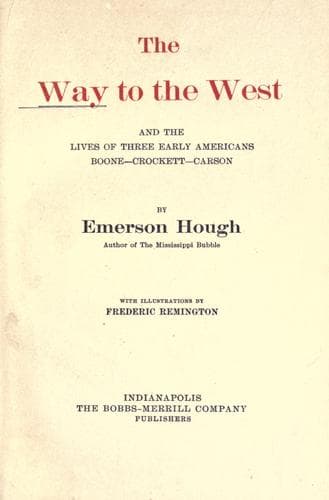
The Way to the West, and the Lives of Three Early Americans: Boone—Crockett—CarsonHough, Emerson
History
The Way to the West, and the Lives of Three Early Americans: Boone—Crockett—Carson
Hough, Emerson
Boone, Daniel, 1734-1820; Carson Kit, 1809-1868; Crockett, Davy, 1786-1836; Mississippi River Valley -- History; West (U.S.) -- History
One Western city, located in that despised territory, during the year
just past showed sales of grain alone amounting to one hundred and
twenty-three million three hundred thousand dollars; of live stock
alone, two hundred and sixty-eight million dollars; of wholesale trade,
seven hundred and eighty-six million two hundred and five thousand
dollars; of manufactures—where manufactures were once held
impossible—the total of seven hundred and forty-one million and
ninety-seven thousand dollars.
It was once four weeks from Maine to Washington; it is now four days
from Oregon. The total wealth of all the cities, all the lands, all the
individuals of that once despised West, runs into figures that surpass
all belief and all comprehension. And this has grown up within less than
a hundred years. The people have outrun all the wisdom of their leaders.
What would Daniel Webster, famous New Englander, doubter and discreditor
of the West, say, were he to know the West to-day?
Yet the men of that day were not so much to blame, for they were in the
infancy of transportation, and as no army is better than its commissary
trains, so is no nation better than its transportation. We were still in
the crude, primitive, down-stream days. Steam had not yet come upon the
great interior waterways. The west-bound mountain roads across the
Alleghanies were still only narrow tracks worn by the feet of
pack-horses that carried mostly salt and bullets. The turnpikes fit for
wagon traffic were Eastern affairs only. The National Road, from
Wheeling to the westward, was restricted in its staging possibilities.
Between the hardy Western population and its earlier home there rose the
high barrier of the Appalachians, to ascend whose streams meant a long,
grievous and dangerous journey, a Journey commercially impracticable.
The first traffic of the old mountain road was in salt and bullets, and
it was a traffic that all went one way. The difficulties of even this
crude commerce led to the establishment, as the very first manufacture
ever begun in the West, of works for the production of salt. Bullitt’s
Lick, on Salt Creek, was one of the earliest, if not the earliest,
manufacturing community west of the Alleghanies, and part of the
downstream trade of the day was in carrying kettles from Louisville down
the Ohio and up Salt Creek to the lick. This route was in hostile Indian
country, and every voyage held its own terrors.
We may note, then, the beginning of the commercial West in the local
necessities of that West. For the first west-bound generation the
problem of transportation had been largely a personal one. The first
adventurers, with little baggage but the rifle and the ax, able to live
on parched corn and jerked venison, with women almost as hardy as men,
neither possessed nor cared for the surplus things of life. They
subsisted on what nature gave them, seeking but little to add to the
productiveness of nature in any way.
Public-domain text, read in full here on John Shaqi.
Reviews
Reviews
No reviews yet
Be the first to share your thoughts on this work.
Join the Discussion
Join the discussion
Sign in to leave a comment or review.
Sign InorCreate an account