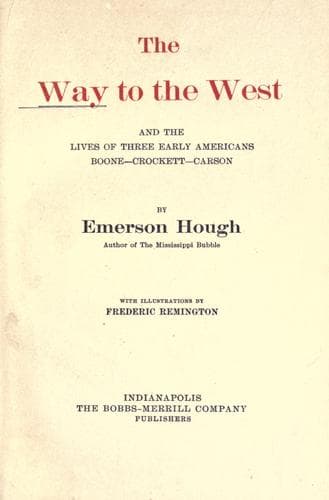
The Way to the West, and the Lives of Three Early Americans: Boone—Crockett—CarsonHough, Emerson
History
The Way to the West, and the Lives of Three Early Americans: Boone—Crockett—Carson
Hough, Emerson
Boone, Daniel, 1734-1820; Carson Kit, 1809-1868; Crockett, Davy, 1786-1836; Mississippi River Valley -- History; West (U.S.) -- History
For forty years before this time the fur trade had had its depot at the
city of St. Louis. For a hundred years there had been a settlement on
the Great Lakes. For nearly a hundred years the town of New Orleans had
been established. Here and there, between these foci of adventurers,
there were odd, seemingly unaccountable little dots and specks of
population scattered over all the map, product of that first uncertain
hundred years. Ohio, directly west of the original Pennsylvania hotbed,
was left blank for a long time, and indeed received her first population
from the southward, and not from the East, though the New Englander,
Moses Cleveland, founded the town of Cleveland as early as 1796.
Lower down in the great valley of the Mississippi was a curious,
illogical, and now forgotten little band of settlers who had formed what
was known as the “Mississippi Territory.” Smaller yet, and more
inexplicable, did we not know the story of the old water-trail from
Green Bay to the Mississippi, there was a dot, a smear, a tiny speck of
population high up on the east bank of the Mississippi, where the
Wisconsin emptied.
These valley settlements far outnumbered all the population of the state
of Ohio, which had lain directly in the latitudinal path of the star.
The West was beginning to be the West. The seed sown by Marquette the
Good, by Hennepin the Bad, by La Salle the Bold, by Tonty the Faithful,
seed cultivated by Boone and Kenton, by Sevier and Robertson and scores
and hundreds of stalwart early Westerners—seed despised by an ancient
and corrupt monarchy—had now begun to grow.
Yet, beyond the farthest settlements of the West of that day, there was
still a land so great that no one tried to measure it, or sought to
include it in the plans of family or nation. It was all a matter for the
future, for generations much later. Compared with the movements of the
past, it must be centuries before the West—whatever that term might
mean—could ever be overrun. That it could ever be exhausted was, to be
sure, an utterly unthinkable thing.
There were vague stories among the hardy settlers about new lands
incredibly distant, mythically rich in interest. But who dreamed the
import of the journey of strong-legged Zebulon Pike into the lands of
the Sioux, and who believed all his story of a march from Santa Fé to
Chihuahua, and thence back to the Sabine? What enthusiasm was aroused
for the peaceful settler of the Middle West, whose neighbor was fifty
miles away, by that ancient saga, that heroically done, Homerically
misspelled story of Lewis and Clark? There was still to be room enough
and chance enough in the West for any and all men.
Public-domain text, read in full here on John Shaqi.
Reviews
Reviews
No reviews yet
Be the first to share your thoughts on this work.
Join the Discussion
Join the discussion
Sign in to leave a comment or review.
Sign InorCreate an account