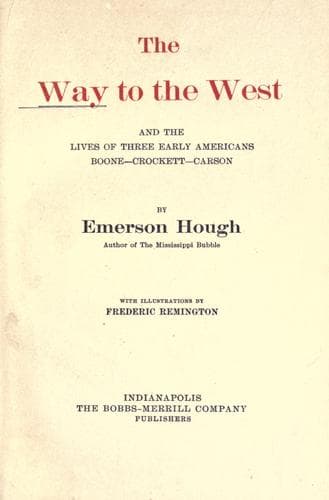
The Way to the West, and the Lives of Three Early Americans: Boone—Crockett—CarsonHough, Emerson
History
The Way to the West, and the Lives of Three Early Americans: Boone—Crockett—Carson
Hough, Emerson
Boone, Daniel, 1734-1820; Carson Kit, 1809-1868; Crockett, Davy, 1786-1836; Mississippi River Valley -- History; West (U.S.) -- History
The progress of civilization, accelerated with the passing of each
century, was none the less slow at this epoch. There was an ictus here
in the pilgrimage of humanity. It was as though the Fates wished that
for a brief time the world might see the spectacle of a land of help and
hope, of personal initiative and personal ambition. The slow-moving star
of the West trembled and quivered with a new and unknown light, caught
from these noble lakes and rivers, reflected from these mountains and
these skies.
The stars of a new heaven looked down on another king, a king in
linsey-woolsey. France kicked him forth a peasant, and, born again, he
scorned the petty limitations of her seigniories, and stood on her
rejected empire, the emperor of himself. England rotted him in her mines
and ditches, but before the reversed flags of England were borne home
from her war which did not subjugate, this same man, under another sky,
was offering hospitality, and not obeisance, to her belted earls.
-----
Footnote 5:
The Century Magazine; Continued.
CHAPTER VII
ORIGIN OF THE PIONEER
“If we call the roll of American scouts, explorers, trappers, Indian
fighters of the Far West; of men like John Colter, Robert McClellan,
John Day, Jim Bridger, Bill Williams, Joe Meek, Kit Carson and their
ilk, who trapped and fought over every nook and cranny of the Far West,
from the Canadian divide to the ‘starving Gila,’ we shall find that most
of them were of the old Shenandoah-Kentucky stock that made the first
devious trail from Pennsylvania along and across the Appalachians.”
This statement of a well-advised writer is curious and interesting to
any student of the real West. It applies, also, of course, and much more
closely, to those earlier pioneers that explored the first West, that of
the Mississippi valley; the Boones, Kentons, Harrods, Finleys, Bryans,
Stuarts and hundreds of others of the fighting breed of Virginia and
North Carolina, the families of nearly all of whom had made one or more
pilgrimages to the south or even to the southeastward before the great
trek westward over the Blue Ridge and the Alleghanies.
America owes much of her national character and a vast part of her
national territory to the individual initiative of these bold souls, who
waited for no policies, no purchases, no leaderships, but pressed on,
rifle and ax at hand, to find and hold our West for us. To-day we forget
these men. The names of the captains of enterprise are lost in the
tawdry modern lists of our so-called captains of industry. To-day, in a
time that is fast becoming one of American serfdom, we lose in the haze
of a national carelessness the figures of that earlier and more glorious
day when the magnificent American West offered free scope and
opportunity to a population wholly made up of men of daring, of
individuality, of initiative, of self-leadership.
Public-domain text, read in full here on John Shaqi.
Reviews
Reviews
No reviews yet
Be the first to share your thoughts on this work.
Join the Discussion
Join the discussion
Sign in to leave a comment or review.
Sign InorCreate an account