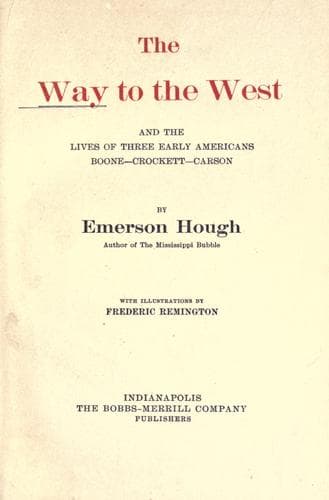
The Way to the West, and the Lives of Three Early Americans: Boone—Crockett—CarsonHough, Emerson
History
The Way to the West, and the Lives of Three Early Americans: Boone—Crockett—Carson
Hough, Emerson
Boone, Daniel, 1734-1820; Carson Kit, 1809-1868; Crockett, Davy, 1786-1836; Mississippi River Valley -- History; West (U.S.) -- History
In regard to the classification of this material, varied and apparently
heterogeneous, yet really interdependent, under the four epochs or
volume-heads mentioned, I refer to the table given on another page.
As justification of what might be called presumption on the part of the
writer in undertaking a work of this nature, he has only to plead a
sincere interest in the West, which was his own native land; a love for
that free American life now all too rapidly fading away; and a deep
admiration for the accomplishments of that American civilization which
never was and never will be any better than the man that made it. It has
not been the intention herein to write a history of the American people,
but a history of the American man.
EMERSON HOUGH.
Chicago, Illinois, June, 1903.
------------------------------------------------------------------------
THE WAY TO THE WEST
CHAPTER I
THE AMERICAN AX
I ask you to look at this splendid tool, the American ax, not more an
implement of labor than an instrument of civilization. If you can not
use it, you are not American. If you do not understand it, you can not
understand America.
This tool is so simple and so perfect that it has scarcely seen change
in the course of a hundred years. It lacks decoration, as do the tools
and the weapons of all strong peoples. It has no fantastic lines, no
deviations from simplicity of outline, no ornamentations, no
irregularities. It is simple, severe, perfect. Its beauty is the beauty
of utility.
In the shaft of the ax there is a curve. This curve is there for a
reason, a reason of usefulness. The simple swelling head is made thus
not for motives of beauty, but for the purpose of effectiveness. The
shaft, an even yard in length, polished, curved, of a formation that
shall give the greatest strength to a downright blow in combination with
the greatest security to the hand-grasp, has been made thus for a
century of American life. This shaft is made of hickory, the sternest of
American woods, the one most capable of withstanding the hardest use. It
has always been made thus and of this material.
Public-domain text, read in full here on John Shaqi.
Reviews
Reviews
No reviews yet
Be the first to share your thoughts on this work.
Join the Discussion
Join the discussion
Sign in to leave a comment or review.
Sign InorCreate an account