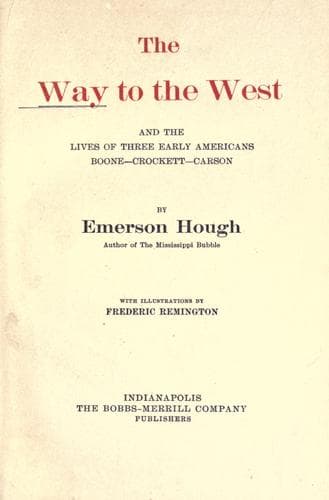
The Way to the West, and the Lives of Three Early Americans: Boone—Crockett—CarsonHough, Emerson
History
The Way to the West, and the Lives of Three Early Americans: Boone—Crockett—Carson
Hough, Emerson
Boone, Daniel, 1734-1820; Carson Kit, 1809-1868; Crockett, Davy, 1786-1836; Mississippi River Valley -- History; West (U.S.) -- History
The metal head or blade of the American ax is to-day as it has always
been. The makers of axes will tell you that they scarcely know of any
other model. The face of the blade is of the most highly tempered steel
for a third or half of its extent. The blade or bitt is about eight
inches in length, the cutting edge four and seven-eighths to five inches
in width. The curve of this edge could not, by the highest science, be
made more perfect for the purpose of biting deepest at the least outlay
of human strength. The poll or back of the ax is about four inches in
width, square or roughly rounded into such form that it is capable of
delivering a pounding, crushing or directing blow. The weight of the
ax-head is about four pounds, that is to say from three and one-half to
five pounds.
With the ax one can do many things. With it the early American blazed
his way through the trackless forests. With it he felled the wood
whereby was fed the home fire, or the blaze by which he kept his distant
and solitary bivouac. With it he built his home, framing a fortress
capable of withstanding all the weaponry of his time. With it he not
only made the walls, but fabricated the floors and roof for his little
castle. He built chairs, tables, beds, therewith. By its means he hewed
out his homestead from the heart of the primeval forest, and fenced it
round about. Without it he had been lost.
At times it served him not only as tool, but as weapon; nor did more
terrible weapon ever fit the hand of man. Against its downright blow
wielded by a sinewy arm the steel casques of the Crusaders had proved
indeed poor fending. Even the early womankind of America had
acquaintance with this weapon. There is record of a woman of early
Kentucky who with an ax once despatched five Indians, who assailed the
cabin where for the time she had been left alone.
It was a tremendous thing, this ax of the early American. It cleared
away paths over hundreds of miles, or marked the portages between the
heads of the Western waterways, which the early government declared
should be held as public pathways forever. In time it became an agent of
desolation and destruction, as well as an agent of upbuilding and
construction. Misguided, it leveled all too soon and wastefully the
magnificent forests of this country, whose superior was never seen on
any portion of the earth. Stern, simple, severe, tremendous,
wasteful—truly this was the typical American implement.
CHAPTER II
THE AMERICAN RIFLE
Public-domain text, read in full here on John Shaqi.
Reviews
Reviews
No reviews yet
Be the first to share your thoughts on this work.
Join the Discussion
Join the discussion
Sign in to leave a comment or review.
Sign InorCreate an account