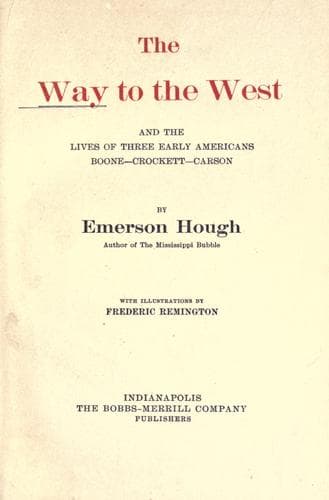
The Way to the West, and the Lives of Three Early Americans: Boone—Crockett—CarsonHough, Emerson
History
The Way to the West, and the Lives of Three Early Americans: Boone—Crockett—Carson
Hough, Emerson
Boone, Daniel, 1734-1820; Carson Kit, 1809-1868; Crockett, Davy, 1786-1836; Mississippi River Valley -- History; West (U.S.) -- History
In times of such continual excitement and danger it is small wonder that
there has been but scant record kept of individual deeds of daring.
Boone himself was not wont to boast of his own prowess, and regarding
his deeds of arms there are not many authentic anecdotes.
One of the best known of his adventures was that in which he met two
savages in the forest while he himself was alone. Those were flint-lock
days, and Boone was, according to the story, able, by watching the flash
of the first savage’s rifle, to throw himself out of the way of the
bullet. This manœuver he repeated with the second Indian. Then he calmly
shot one Indian dead with his rifle, closed with the other, received a
blow of his tomahawk on his own rifle barrel, and killed the savage with
his knife. A statue commemorating this feat was later placed above the
south door of the rotunda in the Capitol at Washington.
There was need in Boone’s case of fortitude, not only of the physical
but of the moral sort. In 1792 Kentucky, which had formerly been a
county of the state of Virginia, was set up as a state by itself, with
courts, jails, judges, lawyers and all the appurtenances of the
artificial civilization that Boone had hoped to leave forever behind
him.
Then came lawsuits regarding the lapping titles. Daniel Boone, his blue
eyes troubled and bewildered, found himself among the haggling officials
of the law courts. It broke his heart. Stunned but not protesting, he
gave up that beautiful land he had enabled all these others to find and
to hold. He was old now, and had fought the main fight of his life only
to find himself the loser.
He left now for the mouth of the great Kanawha, but found the hunting
poor. A son of his had crossed the Mississippi River and sent back word
that there was still a West, still a country where were buffalo and elk,
where were otter and beaver in the streams. There was to be one more
pilgrimage for Daniel Boone, a pilgrimage down the Ohio River, ending in
the region, still wilderness, not far from the point that is now the
city of St. Louis. Bear in mind that this latter point was not within
the United States. Daniel Boone was an emigrant from the land he had
founded. He was going now out from under the infant Stars and Stripes.
In token of his character, the Spanish governor of Louisiana gave Boone
some sort of trifling commission. He was made commandant or syndic, an
official with about the same importance as a country justice of the
peace to-day. By the terms of his settlement in that country Boone was
entitled to a tract of something like ten thousand acres of land. He was
wrongly informed that, as he was an officer of the state, he need not
settle nor improve his land. Once more a fatal mistake for the man who
knew the book of nature better than the printed page.
Public-domain text, read in full here on John Shaqi.
Reviews
Reviews
No reviews yet
Be the first to share your thoughts on this work.
Elsewhere in the archive
Join the Discussion
Join the discussion
Sign in to leave a comment or review.
Sign InorCreate an account