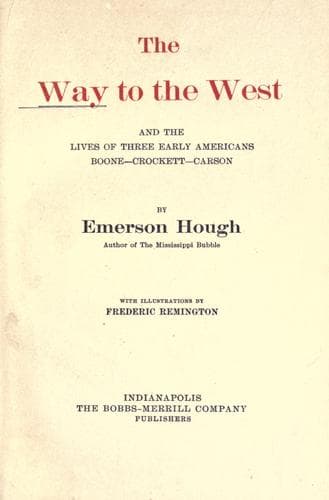
The Way to the West, and the Lives of Three Early Americans: Boone—Crockett—CarsonHough, Emerson
History
The Way to the West, and the Lives of Three Early Americans: Boone—Crockett—Carson
Hough, Emerson
Boone, Daniel, 1734-1820; Carson Kit, 1809-1868; Crockett, Davy, 1786-1836; Mississippi River Valley -- History; West (U.S.) -- History
Late in his life we find the American government, now reaching its
control over this trans-Missouri country, taking up the question of
Boone’s tract of land and allowing him, with extreme generosity,
one-tenth of that which by every right and title of justice ought to
have been his own in fee simple in return for what he had done for the
civilization of America. This was the poor pittance that Daniel Boone,
one of the great Americans, was able to hand down to his posterity.
With this poor heritage go the few incidents of a meager and in some
cases uncertain personal history, the main facts of which have been
given above. There is even uncertainty, or rather discrepancy, regarding
the date of his death. One writer states that he died at the age of
eighty-four, in the year 1818. The date of his death was really
September twenty-sixth, 1820, he being at that time eighty-six years of
age.
In his later years Boone kept up those practices that had endeared
themselves to him in his earlier lifetime. In a mild way he was a
trapper, and always he was a hunter. Even when he had passed his
eightieth year he went regularly each fall in pursuit of the deer, the
turkey, the elk or the furred animals, or followed his simple pastime of
squirrel hunting, in which he was very expert. It was his custom on
these excursions to exact a promise from his attendant that, in case of
his death, his body should be properly cared for. He long kept his
coffin under his bed at his home, near Charette, Missouri. Once, taken
sick in camp, he marked out the place for his grave, and told his negro
servant (some say his Indian friend or servant) what should be done with
his body.
From this indisposition, however, he recovered, and went on several
other hunts later. Failing gradually, though not from any specific
disease, Boone met the great and final enemy with the same fortitude
that had been with him all his life. He had said farewell to all earthly
ambitions, and was ready to die when the time might come. He kept the
coffin under his bed not in any bravado, but in a simple wish for
complete preparedness. His personal habits remained sweet and simple as
of old.
Boone seems to have wandered a little farther to the West than his home
near St. Louis. It is said that he “saw the mouth of the Kansas River,”
and that he noted, with the impatient longing of an old man, the passing
up-stream, into the mysterious Northwest, of those early parties of fur
traders, the voyagers who were now heading the far Western American
migration. It was now too late in the closing years. It is said that he
trapped on the Kaw and the Osage, and he is said to have made one
journey “up the Missouri, and to have reached the mouth of the
Yellowstone”, whence he was driven back by savages.
Public-domain text, read in full here on John Shaqi.
Reviews
Reviews
No reviews yet
Be the first to share your thoughts on this work.
Elsewhere in the archive
Join the Discussion
Join the discussion
Sign in to leave a comment or review.
Sign InorCreate an account