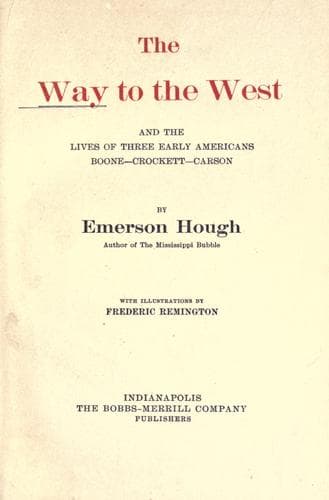
The Way to the West, and the Lives of Three Early Americans: Boone—Crockett—CarsonHough, Emerson
History
The Way to the West, and the Lives of Three Early Americans: Boone—Crockett—Carson
Hough, Emerson
Boone, Daniel, 1734-1820; Carson Kit, 1809-1868; Crockett, Davy, 1786-1836; Mississippi River Valley -- History; West (U.S.) -- History
His sons and grandsons were figures in Western history, always
frontiersmen, travelers. A granddaughter became the wife of a governor
of Oregon. His grandson, Kit Carson, was to hold fast the family
traditions on many a Western trail; but there were to be no more trails
for Daniel Boone. Overtaken once more by America, once more surrounded
by the civilization from which he had by choice always alienated
himself, he at length lay down peacefully to his final sleep beneath the
trees.
Some twenty-five years after his death, the legislature of Kentucky
awakened to a sense of the greatness of this man, and to the onerous
nature of that debt of gratitude under which he had placed his
commonwealth. By virtue of a special enactment, the bodies of Boone and
his faithful wife were moved from their Missouri home, eastward across
the Mississippi River, and laid at rest in the cemetery of Frankfort,
close to that original stockade where, supported by an “unwavering
fortitude”, there first flew the hard beset flag of the west-bound.
These coffins came garlanded with flowers, heralded with music,
surrounded with tardy honors. They were laid away on September
thirteenth, 1845. There were effusive speeches in abundance, the chief
oration being pronounced by Mr. Crittenden, “the leading orator of his
time,” as he is called in the chronicle. Thus at last this primeval
patriarch, this Father of the Frontier, this leader of the Western
home-builders, came home to sleep on the soil that was by right his own.
-----
Footnote 8:
There was long known a tree near the Cumberland which bore this quaint
inscription: “D. Boon Cilled A Bar on this tree, year 1760.”
Footnote 9:
There is continual discrepancy among the historians regarding these
incidents. Thus another writer states that Boone and Stewart were
twice taken prisoners by the savages, but that no northward journey
was made by the Indians, who simply kept the prisoners at their camps,
and at length dismissed them with a warning to leave Kentucky, as it
was their own hunting ground and belonged to the Indians only. Again
there seems confusion in the stories of the death of Neeley and
Stewart. One account is that Boone saw Stewart shot down and scalped;
another states that Stewart disappeared, and that no idea of his fate
was obtained until years afterward, when in a hollow tree Boone found
a skeleton, near which was Stewart’s powder horn, which had his name
inscribed upon it.
CHAPTER IX
A FRONTIER REPUBLIC
If we have been successful in the first of our undertakings, that of
investigating the first stage of the American transcontinental
pilgrimage, which brought the Anglo-Saxon civilization permanently into
the Mississippi valley, we must have gained in our earlier chapters some
knowledge of the characteristics of the west-bound men, and of the
motives that actuated them.
Public-domain text, read in full here on John Shaqi.
Reviews
Reviews
No reviews yet
Be the first to share your thoughts on this work.
Elsewhere in the archive
Join the Discussion
Join the discussion
Sign in to leave a comment or review.
Sign InorCreate an account