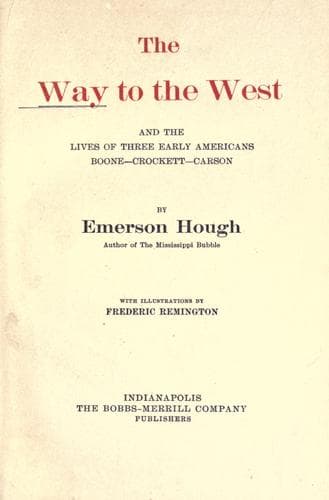
The Way to the West, and the Lives of Three Early Americans: Boone—Crockett—CarsonHough, Emerson
History
The Way to the West, and the Lives of Three Early Americans: Boone—Crockett—Carson
Hough, Emerson
Boone, Daniel, 1734-1820; Carson Kit, 1809-1868; Crockett, Davy, 1786-1836; Mississippi River Valley -- History; West (U.S.) -- History
We shall also have noticed the beginning of a new type of man,—a man
born of new problems, new necessities. Obliged to think and act for
himself, it was natural that this man should learn to be restive when
others thought for him. It was not to be expected that the men of New
England and New York should understand this new man. We do not
understand the Asiatics to-day; and at the time Daniel Boone reached the
Mississippi it was farther from the Mississippi to New York than it is
from New York to the Philippines to-day.
The American pilgrimage, whether at times painful, halting, broken, or
at other times rapid, feverish, insane, has at the one time or the other
been no better than the transportation at hand. The long, hard roads,
the slow travel of those early trans-Appalachian days were at the bottom
of the greatest national problem of those days.
The men of the East could not believe that loyalty might be expected of
the men of the West; and the latter, feeling the force of their
geographical position, and feeling also their own ability to take care
of themselves, openly talked of all manner of schisms, sectionalisms and
governmental speculations. The West talked secession almost before it
was a West. Under the conditions of those days it was small crime that
it did so; the fact proved no disloyalty of the old type, but the
strength and vigor of the new type of American that had now been born,
which declared itself able to hold and govern its own new-found world.
It may profit us at this stage of our study to turn for a time from the
individual frontiersman and settler, and to take up in more concrete
form some of the things that these frontiersmen and settlers did in
combination—some of the phases of the Western civilization as affected
by the ever present problems of transportation.
The question of geography, which is the same as to say the question of
transportation, led to more than one attempt to set up entirely
independent governments west of the Allegheny Divide, just as it also
much affected the destinies of the unborn states of the Northwest
Territory—Asenesipia, Pelesipia, Cherronesus, and others. Of these
divers attempts at secession, some were honestly based upon a wish for
commercial development that did not seem possible in connection with a
government situated far to the east, at the end of impassable mountain
roads. Other attempts were mere personal intrigues, carried on with a
view to personal advantage, as was the effort of the unspeakable
Wilkinson to alienate the population of the Mississippi valley from the
standards of the government at Washington. There were other attempts,
honest attempts at secession, or more properly speaking, segregation, on
the part of considerable communities whose interests, under the
conditions of the time, seemed far from identical with those of the
tidewater population.
Public-domain text, read in full here on John Shaqi.
Reviews
Reviews
No reviews yet
Be the first to share your thoughts on this work.
Elsewhere in the archive
Join the Discussion
Join the discussion
Sign in to leave a comment or review.
Sign InorCreate an account