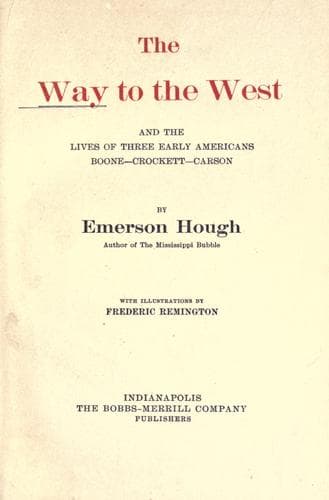
The Way to the West, and the Lives of Three Early Americans: Boone—Crockett—CarsonHough, Emerson
History
The Way to the West, and the Lives of Three Early Americans: Boone—Crockett—Carson
Hough, Emerson
Boone, Daniel, 1734-1820; Carson Kit, 1809-1868; Crockett, Davy, 1786-1836; Mississippi River Valley -- History; West (U.S.) -- History
Chief among the records of these movements for an honest Western
secession stands the story of the famous Free State of Franklin—the
story of an enterprise that to-day we ignorantly call a chimera, an
absurdity or worse, though to the men concerned in it the project seemed
not less than necessary, just and right. The history of this state,
which was born of bad roads and populated by a new breed of Americans,
fits nicely with our theme at this stage of its progress.
As to the extent of this state that once was, but is no more, we
discover that it once included fifteen counties of Virginia, six of West
Virginia, one-third of the state of Kentucky, one-half of Tennessee,
two-thirds of Alabama and one-quarter of Georgia, as those states exist
to-day. Wherefore it may seem that John Sevier and his friends were
dealing with a considerable empire of their own, one much larger than
most folk of to-day realize or understand.
It was one of those first republics west of the Alleghanies, one of
those first instances of spontaneous self-government that have so often
proved the vital strength of the restless yet self-respecting and
law-abiding American character. How the men of the Free State of
Franklin loved their little empire, how they defended it against the
savages that pressed upon its borders, how they held the soil on which
they had set the standard of west-bound civilization—all that is a
legitimate part of the birth-history of the West.
Tennessee to-day honors John Sevier, founder of the Free State of
Franklin, with a shaft recording thirty-five battles and thirty-five
victories. This shaft perpetuates the memory of a population that “in
fifteen years engaged in three revolutions, organized and lived under
five different governments, established and administered the first
independent government in America, founded the first church and the
first college in the West, put in operation the first newspaper west of
the Alleghanies, met and fought the soldiers of King George in half a
dozen battles from King’s Mountain to the gates of Charleston, checked
and beat back four of the most powerful tribes of America, and left to
Tennessee the heritage of a fame founded upon courage and
steadfastness.”
In the times just preceding and following the Revolutionary War, the
American colonies, even though bold enough to encounter successfully the
forces of the mother country, were none the less timid and lacking in
self confidence. There was no strong centralized government, nor was the
loyalty of the different colonies or the different men of each colony a
thing grounded upon reason or even an imperative self interest.
Public-domain text, read in full here on John Shaqi.
Reviews
Reviews
No reviews yet
Be the first to share your thoughts on this work.
Elsewhere in the archive
Join the Discussion
Join the discussion
Sign in to leave a comment or review.
Sign InorCreate an account