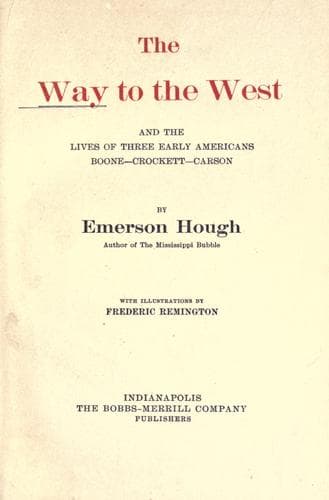
The Way to the West, and the Lives of Three Early Americans: Boone—Crockett—CarsonHough, Emerson
History
The Way to the West, and the Lives of Three Early Americans: Boone—Crockett—Carson
Hough, Emerson
Boone, Daniel, 1734-1820; Carson Kit, 1809-1868; Crockett, Davy, 1786-1836; Mississippi River Valley -- History; West (U.S.) -- History
In no thing was America so rich as in big men, by which I do not mean
“great” men as the term commonly goes. The characters of those early
days stand out clearly and distinctly before us now. It was still the
day of individualism. The men of the Free State were the boldest of
those bold individuals who headed out from the secure settlements of the
seaboard, through gloomy forests, into the unknown wilderness, west of
what was then the backbone of the United States, the rugged Alleghany
range.
These men made their own trails, and they were more careful with the
trails that led westward than with those that connected them with the
East that they had left behind. It was no act of disloyalty that caused
souls bold as these to cast about them in matters of organization and of
government. The day of kings was gone for them. The day of Liberty was
dawning. They carried with them, as have their west-bound fellows ever
since, the principles of self-government. Where the community was, there
arose the Law, there began the state.
With them the community was not the population they had left far behind,
but that population close at hand, banded together, experiencing a
common danger, and entertaining a common ambition,—the population that
had come West and intended to remain. The branches of the Law no longer
sheltered them. They were alone. There was no Law. What, then, was to be
done except to plant anew the seeds of the Law, and let it blossom here,
as it had done before, and has since, on the soil of America?
Yet, poor as was the hold that these people now retained upon the
country that bore them, they were not lacking in active loyalty. When
they heard of the first battles of the Revolution, the first thought of
the men of the “Washington District” was how they might best prove of
service in the conflict that was to ensue. So much might be expected,
for the name of Washington District was given by reason of Sevier’s
friendship with Washington, later to be the first president of the
States; and the District had sent from its scanty numbers fifty
riflemen, under Captain Evan Shelby, who took part on the Indian
battlefield of Point Pleasant, in Virginia, in the fall of 1774.
These men of Washington District were always in the front when the
fighting began, and had it seemed practicable to their leaders, they had
liked nothing better than to join their forces always with those of the
state of North Carolina. There was not one coward in the one hundred and
thirteen men that signed Sevier’s petition to the legislature of North
Carolina. Yet no formal annexation was made by North Carolina, though
John Sevier, Charles Robertson, John Carter and John Hall were seated as
delegates in the North Carolina legislature.
Public-domain text, read in full here on John Shaqi.
Reviews
Reviews
No reviews yet
Be the first to share your thoughts on this work.
Elsewhere in the archive
Join the Discussion
Join the discussion
Sign in to leave a comment or review.
Sign InorCreate an account