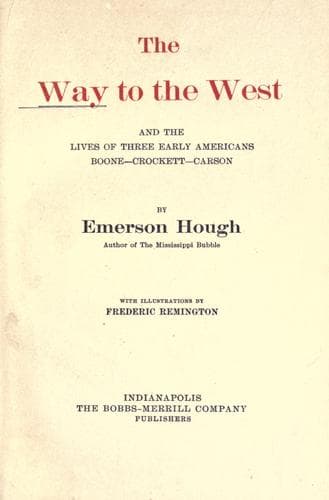
The Way to the West, and the Lives of Three Early Americans: Boone—Crockett—CarsonHough, Emerson
History
The Way to the West, and the Lives of Three Early Americans: Boone—Crockett—Carson
Hough, Emerson
Boone, Daniel, 1734-1820; Carson Kit, 1809-1868; Crockett, Davy, 1786-1836; Mississippi River Valley -- History; West (U.S.) -- History
At this time North Carolina’s state constitution was formed (November,
1776), fixing the western boundary of the state as that named by King
Charles, which reached to “the South Seas.” No one knew what so
indefinite a description might mean, but John Sevier was wise enough to
know that so far from getting the benefit of a stable government and the
protection of the laws, his companions west of the Appalachians would be
in a land practically without law save of their own making. Therefore,
having in view all the time this possibility of a breaking away of a
considerable body of West-American population by its own sheer weight,
he succeeded in passing a resolution in the North Carolina legislature,
stating that the above mentioned limits should not operate as a bar to
the “later establishment of one or more governments west of North
Carolina, by consent of the legislature of that state.” We might call
Sevier another of those great prophets of the West, a prophet who
possessed not only personal courage and daring of his own, but a calm
and sober intellect that foresaw the growing up in the West of not only
one but many governments; albeit not his nor any other mind might at
that time see those changes that were to unite all these component parts
into one effective whole.
There may be interest in tracing from its inception the growth of this
little Western republic. We shall find its history lovingly written, and
as though to hand, by an inhabitant of the state of Tennessee who has
given care in research along those lines.[10] “This lovely mountain
section of the old Watauga settlements,” writes he, “being the cradle of
Tennessee and in some respects also, of the vast valley of the
Mississippi, is rich in historical interest. Here in the month of May,
1772, there was formulated by Sevier, Robertson and others the first
written compact of civil government on American soil. It was then they
drew up the celebrated Watauga Articles of Association, and set up a
government west of the long line of the Blue Ridge and apart from
colonial influence.
“These articles set on foot all the machinery of the new state, the
future Tennessee; they established courts to be presided over by five
commissioners, who had entire control in matters affecting the common
good; they provided a government, paternal but simple and moderate,
albeit summary and firm. This form of government proved satisfactory and
sufficient for a number of years, Sevier and Robertson continuing
leading spirits. At this time they probably believed themselves to be on
Virginia territory, for there was great question as to the location of
the northern boundary line of thirty-six degrees thirty minutes, thence
west to the South Seas—the vague demarcations of Charles II which were
accepted in the legislature of North Carolina.
Public-domain text, read in full here on John Shaqi.
Reviews
Reviews
No reviews yet
Be the first to share your thoughts on this work.
Elsewhere in the archive
Join the Discussion
Join the discussion
Sign in to leave a comment or review.
Sign InorCreate an account