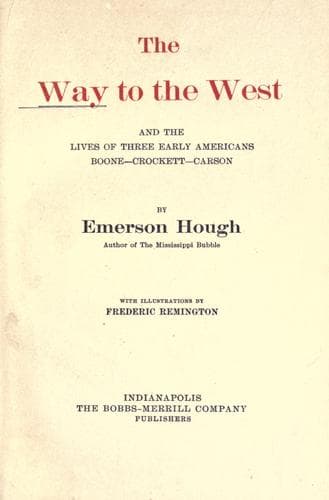
The Way to the West, and the Lives of Three Early Americans: Boone—Crockett—CarsonHough, Emerson
History
The Way to the West, and the Lives of Three Early Americans: Boone—Crockett—Carson
Hough, Emerson
Boone, Daniel, 1734-1820; Carson Kit, 1809-1868; Crockett, Davy, 1786-1836; Mississippi River Valley -- History; West (U.S.) -- History
“It was in 1776 that Sevier drew up his able petition to North Carolina
asking to be annexed thereto. Of the one hundred and thirteen signers,
all but two wrote their own names, which speaks not so badly for these
hardy frontiersmen. Their request was granted, and about April, 1777,
Watauga became a part of North Carolina. It still continued to be known
as the Washington District, largely on account of geographical
situation. At that time it embraced practically all of the present
Tennessee.
“To show the rapid progress of civilization in that remote region, it
may be stated that in 1778 or 1779 Reverend Samuel Doan, a young
graduate of Princeton, came into the Watauga country, organized Salem
Presbyterian church, and in 1780 erected a log cabin school-building,
the first literary institution in Tennessee, if not the first one in the
Mississippi valley, as has been frequently asserted. In the year 1783
this institution was chartered by North Carolina as Martin Academy, and
is known now as Washington College.
“The events leading to the formation of the state of Franklin grew out
of the effort of the state of North Carolina to pay her share of the
thirty-eight millions of the Revolutionary War debt. Congress proposed
to sell all the vacant lands in the several states, against the pro rata
indebtedness of such states. Therefore, in June, 1784, the (North
Carolina) legislature passed an act giving all of Washington District to
the United States. This gift was conditioned upon an acceptance within
two years, otherwise the act was to be null and void.”
This transfer of the sturdy population of the district brought up
questions somewhat in advance of those we argue to-day regarding
government without the consent of the governed, and the transfer of
territory without the consent of the inhabitants. At first the
frontiersmen seemed not to object to the change, but reflection showed
them that the act failed to give them any sort of civil or military
government during the two years Congress might elect to employ before
accepting the gift.
This contingency justly alarmed the population of Washington District.
They found themselves inhabitants of a No-Man’s-Land, an outlaw’s land,
living neither under a government of their own establishing, nor any
other whatsoever. In these unusual and perplexing circumstances it was
no wonder that the people of the District called a convention. This
meeting was held at Jonesboro, August, 1784, John Sevier himself
presiding. Witness now the wisdom of his proviso in the session of the
North Carolina legislature, which, in short, contemplated precisely the
act that was now taken. It was resolved to set up another government,
and these hardy citizens, so capable of self-government, greeted with
applause the establishment of a free and independent state. The
convention adjourned to meet again in November, to ratify the
constitution and further to complete the organization of the state
government.
Public-domain text, read in full here on John Shaqi.
Reviews
Reviews
No reviews yet
Be the first to share your thoughts on this work.
Elsewhere in the archive
Join the Discussion
Join the discussion
Sign in to leave a comment or review.
Sign InorCreate an account