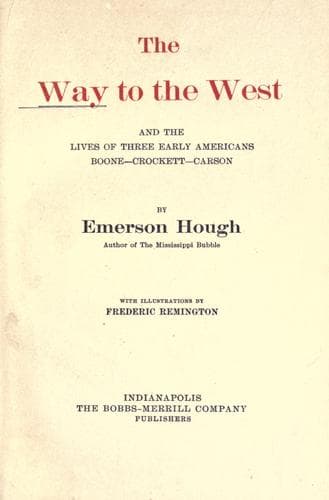
The Way to the West, and the Lives of Three Early Americans: Boone—Crockett—CarsonHough, Emerson
History
The Way to the West, and the Lives of Three Early Americans: Boone—Crockett—Carson
Hough, Emerson
Boone, Daniel, 1734-1820; Carson Kit, 1809-1868; Crockett, Davy, 1786-1836; Mississippi River Valley -- History; West (U.S.) -- History
“Meantime,” continues our historian, “North Carolina, becoming alarmed
at the state of affairs, repealed the act of cession of Washington
District, gave to the secessionists a superior court of their own, and
made Sevier brigadier-general of the organized militia. All of this was
most probably misunderstood by the people, who proceeded to elect
delegates to another convention, over which Sevier presided, though he
steadily protested against a separation. A constitution was, however,
adopted, an election for representatives was ordered, and when that body
met, Sevier was elected governor and all the machinery of the new state
set in motion.”
This little Western republic certainly seemed to have trouble in finding
itself. Its very name is even to-day a matter of discussion. One
writer[11] says: “The Washington District declared itself independent,
and organized a government under the name of Frankland. The name was
afterward changed to Franklin.” The writer just quoted[12] states:
“There was considerable discussion as to the spelling of the name, many
insisting in convention that ‘Frankland,’ that is to say ‘Freeland,’
should be the name. Others were for following the name of Benjamin
Franklin. The latter spelling carried by a very small majority in the
convention, as cited by Ramsey. There is, however, yet extant one letter
written by General William Cocke from Frankland.”
The name Franklin was the one officially accepted. Franklin himself did
not know of the honor he had received until some eighteen months after
it had been conferred. He declined to be caught by this compliment, did
not commit himself in favor of the new commonwealth, but advised the
citizens of this pseudo-state to submit their claims to Congress, and
indeed outlined to them the virtue of that centralized government which
was later to be felt on both sides of the Alleghanies.
This new population now had a government and a scheme of education, and
indeed a general plan of living and growth and progress, yet it lacked
many of the advantages of an older civilization. There must, of course,
be revenue, and hence taxes; and since a currency was not forthcoming,
the legislature passed an act authorizing the payment of taxes and
salaries in articles of trade. Legal tender were beaver, otter and deer
skins, each at six shillings; raccoon and fox skins, worth one shilling
and three pence each. Beeswax, at one shilling a pound, was also legal
tender; and, most remarkable of all, though there were those who
wondered not at the precedent, it was provided that taxes and official
salaries might also be paid in rye whisky, at three shillings six pence
a gallon, or in peach brandy at three shillings a gallon! As to the
extent of the reward of practical politics in that day, we may cite an
act passed by that same legislature.
Public-domain text, read in full here on John Shaqi.
Reviews
Reviews
No reviews yet
Be the first to share your thoughts on this work.
Elsewhere in the archive
Join the Discussion
Join the discussion
Sign in to leave a comment or review.
Sign InorCreate an account