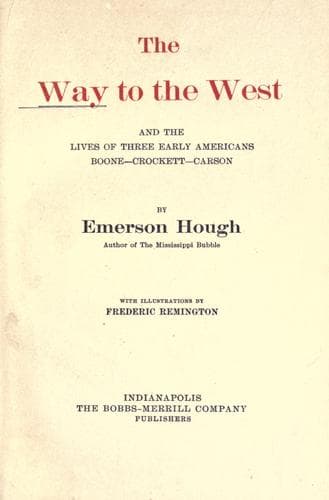
The Way to the West, and the Lives of Three Early Americans: Boone—Crockett—CarsonHough, Emerson
History
The Way to the West, and the Lives of Three Early Americans: Boone—Crockett—Carson
Hough, Emerson
Boone, Daniel, 1734-1820; Carson Kit, 1809-1868; Crockett, Davy, 1786-1836; Mississippi River Valley -- History; West (U.S.) -- History
“Be it enacted by the General Assembly of the State of Franklin, and it
is hereby enacted by the authority of same, that from and after the
first day of January next, the salaries of this commonwealth shall be as
follows:
“His Excellency, the Governor, per annum, a hundred deer skins.
“His Honor, the Chief Justice, five hundred deer skins.
“The Secretary to His Excellency, the Governor, five hundred raccoon
skins.
“County Clerk, three hundred beaver skins.
“Clerk of the House of Commons, two hundred raccoon skins.
“Members of the Assembly, per diem, three raccoon skins.
“Justice fees for serving a warrant, one mink skin.”
Crude enough seem such devices to us to-day, yet we must remember that
we are in close chronological touch with those very times. Nor did the
new state seem to do ill with its self-established machinery of
government. Just as the people of America retained something of the
vital and useful customs and standards of old England, discarding the
ancient and outworn, so did the people of the state of Franklin cling to
the standards of their mother state of North Carolina. The constitution
of North Carolina was adopted without very great change.
“For some time,” goes on our writer, “the state of Franklin moved on
serenely, until Governor Sevier officially notified Governor Martin of
North Carolina that his people would no longer recognize the authority
of that state. Governor Martin replied explaining the cession act, and
threatening the ‘revolters’ with armed invasion unless they returned to
their allegiance. This letter, largely circulated, was not without
effect, though in the main the people adhered to the new state.
“North Carolina then passed an act of amnesty for those that cared to
avail themselves of it, which provided for the election of members to
her own legislature. The same act appointed civil and military officers
for the district. Thus there was to be seen the strange spectacle of two
sets of officers over one and the same set of people, ‘Hurrah for
Franklin!’ being the battle cry of one, and ‘Hurrah for North Carolina!’
the watchword of the other. Great confusion followed. Franklin held
courts at Jonesboro, and North Carolina held hers near by, each denying
the authority of the other. The rival officials quarreled and fought
over their supposed rights. The victors turned the vanquished neck and
crop out of doors, and retained possession of the records, such as they
were.
Public-domain text, read in full here on John Shaqi.
Reviews
Reviews
No reviews yet
Be the first to share your thoughts on this work.
Elsewhere in the archive
Join the Discussion
Join the discussion
Sign in to leave a comment or review.
Sign InorCreate an account