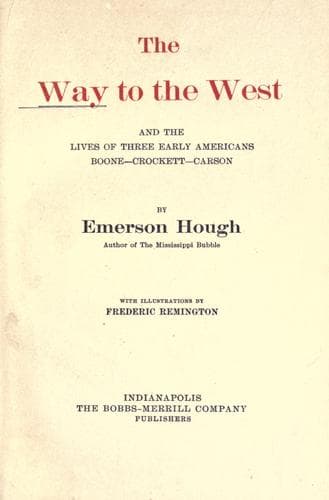
The Way to the West, and the Lives of Three Early Americans: Boone—Crockett—CarsonHough, Emerson
History
The Way to the West, and the Lives of Three Early Americans: Boone—Crockett—Carson
Hough, Emerson
Boone, Daniel, 1734-1820; Carson Kit, 1809-1868; Crockett, Davy, 1786-1836; Mississippi River Valley -- History; West (U.S.) -- History
“Failing to obtain recognition from North Carolina and an admission of
the independence of the state of Franklin, Sevier laid the matter before
Congress. Here he failed. He turned to Georgia, and was told by that
state that Franklin and the old state of North Carolina must settle
their own affairs themselves. Day by day the Franklin party became
weaker, and on the expiration of Sevier’s term as governor no election
was held, and the state of Franklin therefore ceased to exist. Indeed it
is a matter of surprise that it survived four years of such constant and
irritating opposition. The explanation, lies in the fact that no other
man in Tennessee before or since has had so firm a hold upon the popular
heart as did John Sevier. In one instance at least the fickle multitude
was constant.
“Soon after Franklin’s downfall, Sevier was arrested by North Carolina
officers on the charge of treason, the warrant having been granted by
Judge Spencer of the old state, and he was taken over the mountains for
trial at Morganton. There he was at once surrounded by many of his old
King’s Mountain comrades, and after a short sojourn returned home
without trial and without interference. He was soon elected to the North
Carolina senate, where he took his seat, that section of the legislature
restoring to him all his old-time privileges. Almost immediately
thereafter he was elected to Congress (in 1789) from the ‘Washington
District of North Carolina,’ thus becoming the first member of that body
from the valley of the Mississippi.”
All this turmoil as to the bestowal of governmental allegiance was going
forward at the same time that the settlers of Kentucky were raising
their corn under rifle guard, and constantly fighting back the savage
population that hemmed them in. They too were clamoring for national
support, or individual independence. Meantime, too, the intrigues of
Wilkinson in the Mississippi valley were continuing, and the men of the
Free State of Franklin even looked southward for an alliance with the
nation holding control of the mouth of the great Mississippi highway.
The formation of the new state was a blow not so much at the government
at Washington as at the mother state of North Carolina; and the latter
was at first willing enough to have the separation take place, for she
was tired of paying war debts for fighting the Indians on her far-off
frontier.
The times being so far out of joint, we can scarcely wonder that the
hardy Indian fighters under Sevier at one time (September twelfth, 1788)
sent word to the Spanish minister Gardoquoi that they wished to put
themselves under the protection of Spain—a thing to-day difficult to
believe of any part of the American population, yet not wholly
irrational for those times and conditions. Nor is this all of the story
of these little splits and schisms and secessions, which for a time took
place on the Western slope of the Alleghanies.
Public-domain text, read in full here on John Shaqi.
Reviews
Reviews
No reviews yet
Be the first to share your thoughts on this work.
Elsewhere in the archive
Join the Discussion
Join the discussion
Sign in to leave a comment or review.
Sign InorCreate an account