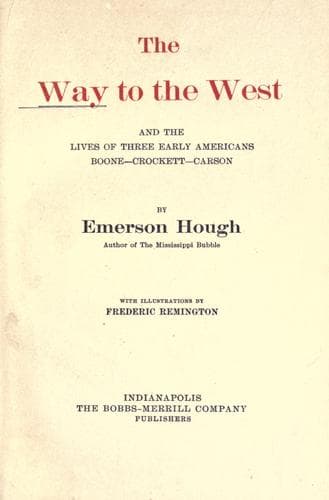
The Way to the West, and the Lives of Three Early Americans: Boone—Crockett—CarsonHough, Emerson
History
The Way to the West, and the Lives of Three Early Americans: Boone—Crockett—Carson
Hough, Emerson
Boone, Daniel, 1734-1820; Carson Kit, 1809-1868; Crockett, Davy, 1786-1836; Mississippi River Valley -- History; West (U.S.) -- History
Another writer[13] describes some of these early transactions. “The
settlers of the district of the Columbia River,” says he, “who were
under the jurisdiction of North Carolina, gave the name of Miro to the
district they had formed; this as evidence of their partiality for the
Spanish government. The promise of protection the inhabitants received
from Gardoquoi was so modified by Miro that the scheme, though
prosecuted for a time with vigor, finally failed from inability of the
secessionists to comply with the conditions of recognition. Yet another
center of sedition was located in the valley of the Mississippi. A
company composed of Alexander Moultrie, Isaac Huger, Major William
Snipes, Colonel Washington and other distinguished South Carolinians was
formed at Charleston in 1789, which purchased from the state of Georgia
fifty-two thousand nine hundred square miles of territory, extending
from the Yazoo to the banks of the Mississippi near Natchez, the
Choctaws, Chicasaws and Spain each claiming a portion of this territory.
The ulterior designs of the company in the purchase and settlement of
the country were carefully concealed for some time.”
The arch conspirator Wilkinson did his best to assume a position of
importance with this little body of malcontents, and freely promised
Miro that he would unite all this population under the flag of Spain. He
naïvely stirred up the Indian savages of the Mississippi valley to renew
their attacks on the Western frontier, in order that the Western
settlers might the more quickly realize the inefficiency of the
government at Washington to afford them the protection they needed.
Meantime also it was quite possible that Great Britain might make an
invasion of Louisiana, by way of the water trail from Canada to the
Mississippi valley. Assuredly the times were troublous, and fortunate
indeed was it that the government at Washington still lived, that good
fortune favored the minds and hands in control.
It was not the wisdom of the government, not the ability of the
political leaders that solved these perplexing problems. Presently they
went far toward solving themselves, as do most American problems to-day.
By this time all the mountain roads and water trails were becoming more
defined and more frequented; the fighting white men were slowly beating
off their savage foes.
Public-domain text, read in full here on John Shaqi.
Reviews
Reviews
No reviews yet
Be the first to share your thoughts on this work.
Elsewhere in the archive
Join the Discussion
Join the discussion
Sign in to leave a comment or review.
Sign InorCreate an account