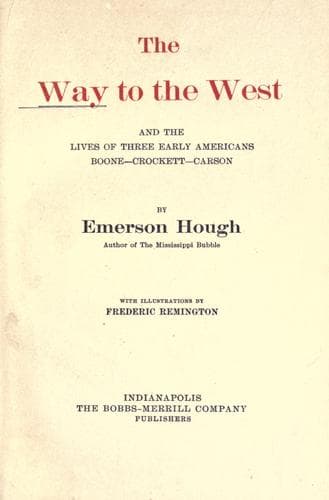
The Way to the West, and the Lives of Three Early Americans: Boone—Crockett—CarsonHough, Emerson
History
The Way to the West, and the Lives of Three Early Americans: Boone—Crockett—Carson
Hough, Emerson
Boone, Daniel, 1734-1820; Carson Kit, 1809-1868; Crockett, Davy, 1786-1836; Mississippi River Valley -- History; West (U.S.) -- History
Then at last came the time when the frontier, held fast by many braided
trails, looked back across the mountains, and resolved to pin fast its
allegiance then and forever to the government that had been left behind,
the government of Americans under principles established and fully
proved on the American soil. The threads that bound fast the new
settlements with the old, the threads that grew and strengthened into
indissoluble bonds, which in spite of the fears of those who dreaded the
accession of any more large territory, held firm the whole wide realm of
the West to the mother colonies on the East, were simply the natural and
artificial trails, later to be blended into a vast network,
intermingling and inextricable, weaving and making permanent the web of
a common and unsectionalized civilization.
Such was the still pure Anglo-Saxon civilization, changed, purified and
strengthened by some generations of tenure of the American soil, at the
time when it reached the great central highway, the mighty Mississippi,
there to pause for a time, facing new problems attendant upon the next
great journey onward and outward in the pathway of the sun.
-----
Footnote 10:
Alexander Hynds, of Dandridge, Tenn.
Footnote 11:
N. P. Langford.
Footnote 12:
Alexander Hynds.
Footnote 13:
N. P. Langford.
------------------------------------------------------------------------
THE WAY TO THE ROCKIES
CHAPTER I
DAVY CROCKETT
There is no figure of speech that so exactly describes the westward
advance of the American population as that which compares it to the
feeding of a vast flock of wild pigeons. These, when they fall on a
forest rich with their chosen food, advance rapidly, rank after rank. As
those in the front pause for a moment to feed, others behind rise and
fly on beyond them, settling for a time to resume their own feeding
operations. Thus the progress of the hosts resembles a series of rolling
waves, one passing ever on beyond the other, each wave changing its own
relative position rapidly, yet ever going forward.
It was so with the American people. The Alleghanies could not stop them
in their west-bound march, nor the terrors of a relentless Indian
warfare, which endangered lives dearer to the rugged frontiersman than
his own. Nothing would do until the pathway of the waters had brought
the American settler to the Mississippi River, the great highway that,
whether by whim, chance, or design, had now become wholly the property
of the growing American government. Having arrived at the Mississippi
River, the population could not rest. Those behind pressed ever on.
Public-domain text, read in full here on John Shaqi.
Reviews
Reviews
No reviews yet
Be the first to share your thoughts on this work.
Elsewhere in the archive
Join the Discussion
Join the discussion
Sign in to leave a comment or review.
Sign InorCreate an account