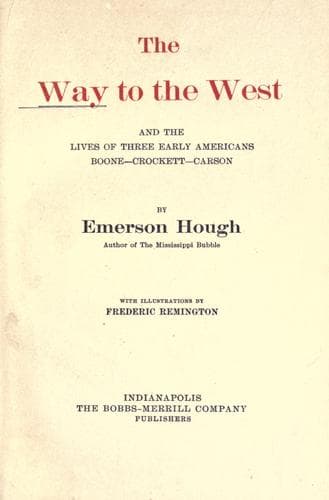
The Way to the West, and the Lives of Three Early Americans: Boone—Crockett—CarsonHough, Emerson
History
The Way to the West, and the Lives of Three Early Americans: Boone—Crockett—Carson
Hough, Emerson
Boone, Daniel, 1734-1820; Carson Kit, 1809-1868; Crockett, Davy, 1786-1836; Mississippi River Valley -- History; West (U.S.) -- History
Meantime he had been elected colonel of militia over a bumptious rival.
Now, all at once, and perhaps originally more as a matter of jest than
anything else, as was the case in his second candidacy, his name came up
for the legislature. Crockett inaugurated a canvass on lines of his own.
In brief, he talked little of politics, for he knew nothing of such
matters. He told a brief story, traded a ’coon skin for a bottle of
liquor, treated the crowd, promised to sell a wolf scalp and treat them
again, and so passed on to the next gathering. He was elected without
difficulty.
But of course misfortune once more must overtake our hero, and he must
move again, this time as far as he can go and not cross the Mississippi
River. This next home, and the last one he established, was made in the
northwestern corner of Tennessee, on the Obion River, near the
Mississippi River, not far from what is now known as Reel Foot Lake, and
in the heart of that wild country then known as the “Shakes.”
This was near the submerged lands affected by the New Madrid
earthquakes, a country naturally rich in many ways. It was a cane-brake
country, a heavily timbered but somewhat broken region, crossed now and
again by terrific windfalls locally known as “hurricanes.” You may see
such country in the Mississippi Delta to-day, two hundred miles south of
Crockett’s home. Crockett’s neighbors on the Obion were three in number,
respectively seven, fifteen and twenty miles distant.
On his trip of exploration he planted his first crop of corn by means of
a sharp stick, just as he had broken the earth at each of his earlier
homes. He was rejoiced to find that the corn grew excellently, and yet
more rejoiced to know that he had found a superb hunting ground. In his
early life his game consisted chiefly of deer and turkey. Here bear,
deer and turkey were very numerous, and there were also elk occasionally
to be seen. The buffalo is never mentioned up to this time in Crockett’s
life, and that animal had probably by this time, 1822, become
practically extinct in Kentucky and Missouri.
Public-domain text, read in full here on John Shaqi.
Reviews
Reviews
No reviews yet
Be the first to share your thoughts on this work.
Elsewhere in the archive
Join the Discussion
Join the discussion
Sign in to leave a comment or review.
Sign InorCreate an account