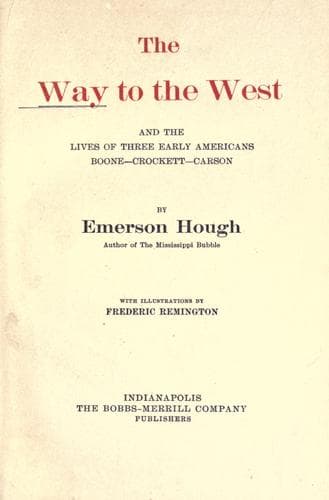
The Way to the West, and the Lives of Three Early Americans: Boone—Crockett—CarsonHough, Emerson
History
The Way to the West, and the Lives of Three Early Americans: Boone—Crockett—Carson
Hough, Emerson
Boone, Daniel, 1734-1820; Carson Kit, 1809-1868; Crockett, Davy, 1786-1836; Mississippi River Valley -- History; West (U.S.) -- History
“Hero—that is a name that ought to be first in war and last in peace,”
says he. Commenting on the faithlessness of the government, he flames
out: “I had considered a treaty as the sovereign law of the land, and
now I hear it considered as a matter of expedience.” This was in
reference to the treatment accorded the southern Indians by the United
States government.
“This thing of man-worship I am a stranger to,” says he, with personal
allusion, of course, to Jackson. In all these sayings he is, it may
naturally be supposed, heartily applauded by the Northerners, who
rejoice in this notable accession to their own ranks.
Davy Crockett, bear hunter and congressman, has now had his chance. He
takes himself seriously, even when he jokes about his being the next
president of the United States. Crockett represents now the success of
perfect digestion, of the perfectly normal nervous system. Nothing
irritates him. The world to him runs smoothly, as it does to any hardy
animal. He cares not for the past and has no concern for the physical
future. His big brain, so long fallow, so long unstirred, begins now to
fill up with thoughts and ideas and comparisons and conclusions. His
reason is clear and bright. He presents to the world the startling
spectacle of a middle-aged man educating himself to the point of an
intelligent statesmanship, and that within the space of a few brief
months or years. He displays a clarity of vision nothing short of
marvelous. His memory of names, of dates and data is something
startling. The world of books remains closed to him, so that he learns
by ear, like a child, but he surprises friends and foes alike. The husk
of the chrysalis has been broken. The Westerner has been born into the
American!
Davy Crockett had thus far never met any danger of a nature to inspire
fear, any difficulty he could not overcome, any hardship he could not
lightly endure. He now encountered one enemy greater than any to be met
with in the wilderness—that great and menacing foe, the political
machine. He found to his sorrow that honor and manhood will not always
serve, and at the summit of his success he met his first and
irremediable defeat.
Crockett, once the politician, now grown into Crockett the eager
student, the earnest statesman, had stirred up animosities too great for
him to overcome. The relentless hand of Jackson smote hard upon
Crockett’s district. There was talk of money, and of votes influenced by
its use. Poor Davy, who went into this last campaign of Congress as
blithely and as sure of success as ever in his life, learned that he had
been defeated by a total of two hundred and thirty votes! Then there
arose from the honest and generous soul of this strange child of the
wilderness a great and bitter cry. He was among the first to exclaim
against the creed of politics pursued as politics, of statesmanship that
is not statesmanship—the creed of party and not of manhood.
Public-domain text, read in full here on John Shaqi.
Reviews
Reviews
No reviews yet
Be the first to share your thoughts on this work.
Elsewhere in the archive
Join the Discussion
Join the discussion
Sign in to leave a comment or review.
Sign InorCreate an account