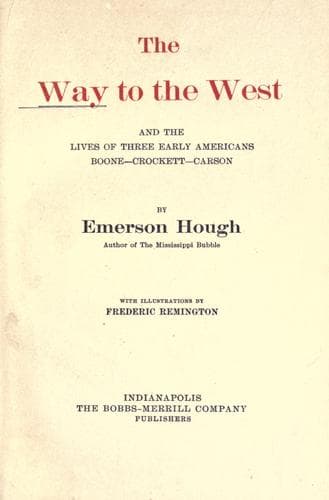
The Way to the West, and the Lives of Three Early Americans: Boone—Crockett—CarsonHough, Emerson
History
The Way to the West, and the Lives of Three Early Americans: Boone—Crockett—Carson
Hough, Emerson
Boone, Daniel, 1734-1820; Carson Kit, 1809-1868; Crockett, Davy, 1786-1836; Mississippi River Valley -- History; West (U.S.) -- History
“As my country no longer requires my services,” he writes, “I have made
up my mind to leave it.” Expressing his determination forthwith to leave
Tennessee and to start for the distant land of Texas, he says, “I have a
new row to hoe, a long and rough one; but I will go ahead.” He adds as
quaintly as ever, “I told my constituents they might all go to hell, and
I would go to Texas.”
We come now to the third and closing stage of the life of David
Crockett, and in order to understand it we must bear in mind the nature
of the opinions then current concerning the new land that to the
Southerners of that time was “The Great West,” the land beyond the
Mississippi. Texas, a magnificent realm eight hundred and twenty-five by
seven hundred and forty-five miles in extent, already had an American
population of nearly forty thousand; and of all wild populations ever
gathered together at any place or time of the world, this was perhaps
the wildest and the most indomitable. There was hardly a soul within the
borders of that great land who was not a fighting man and who had not
come to take his fighting chance. It was fate that Davy Crockett should
drift into this far Southwest and take his chances also.
As to the chances of it, they were not so bad. It was almost sure that
Texas would ultimately be won from Mexico. In 1813 an expedition of
Americans had fought Spain and killed some hundreds of Spaniards, on the
strength of the general claim that the territory of Louisiana extended
westward as far as the Rio Grande, and not merely to the neighborhood of
the Sabine River, as was claimed by Spain. The latter river was in 1819
generally accepted as the boundary line, but this fact did not serve to
stop the Americans.
In 1823 Stephen A. Austin was settling his Mexican grant with his new
colony. These families drew after them the inevitable train of relatives
and friends, so that the great River Road to the South and Southwest
soon began to be pressed by the feet of many pilgrims. In 1821 Lafitte
made his rough settlement at Galveston, and the pirates of Lafitte were
no worse than the average Texas population of that time. There were no
schools, no courts, no law. One writer states that he sat at breakfast
with eleven men, each of whom had pending against him in another state a
charge of murder. Then originated the etiquette of the wild West that
demanded that no one should inquire into his neighbor’s past, nor ask
his earlier name.
Public-domain text, read in full here on John Shaqi.
Reviews
Reviews
No reviews yet
Be the first to share your thoughts on this work.
Elsewhere in the archive
Join the Discussion
Join the discussion
Sign in to leave a comment or review.
Sign InorCreate an account