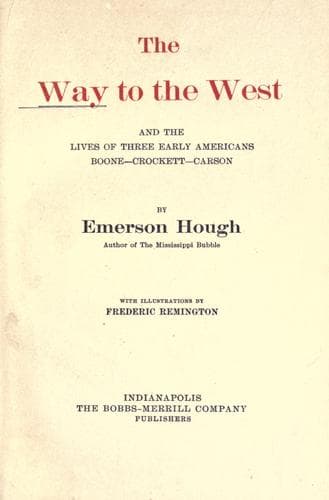
The Way to the West, and the Lives of Three Early Americans: Boone—Crockett—CarsonHough, Emerson
History
The Way to the West, and the Lives of Three Early Americans: Boone—Crockett—Carson
Hough, Emerson
Boone, Daniel, 1734-1820; Carson Kit, 1809-1868; Crockett, Davy, 1786-1836; Mississippi River Valley -- History; West (U.S.) -- History
In 1833 there were twenty thousand Americans that wished Texas to have
an organization separate from the state of Coahuila. They were not so
particular as to what government claimed their state, but they wished to
organize and run it for themselves. Meeting a natural opposition from
Mexico in this enterprise, in the year 1835 they banded their forces,
overturned the Mexican government, and set up a provisional government
of their own. Henry Smith was chosen provisional governor and Sam
Houston commander-in-chief of this wildest of all American republics.
On December twentieth, 1835, these Texans issued their proclamation of
independence, some sixty years after the Declaration of the American
Independence. This meant but one thing. Santa Anna, then as much as
anybody governor of affairs in Mexico, marched with an army, stated to
have numbered seven thousand five hundred men, to besiege the Texans,
whose main body was located at San Antonio. No American doubted the
ultimate issue. All the South knew that the wild and hardy population of
this new region would beat back the weak Latin tenants of the soil. The
matter was well discussed and well understood. It was not
knight-errantry, therefore, so much as politics, that led Davy Crockett
southward into this wild hornets’ nest. Rather should we say that all
this movement was part of the mighty, inexplicable, fateful,
irresistible Anglo-Saxon pilgrimage across this continent. It was a New
World. These new men were those fitted to occupy and hold it.
At this time the historian of Crockett falls on a curious difficulty.
There is published what purports to be an autobiography of David
Crockett’s life, a linsey-woolsey affair, made up partly of good English
and partly of rough backwoods idiom such as we are accustomed to
associate with the speech of this singular man. This “autobiography”
purports to be continued after Crockett leaves his Tennessee home for
far-off Texas. Yet at this point its style and subject matter assume
such shape as to lead one inevitably to conclude that Crockett did not
write it. There are many contradictions and discrepancies, and much of
the detailed story of Crockett’s wanderings in the Southwest is denied
by practically the only eye-witness of the time qualified to tell of his
experiences—that Jonathan H. Greene (the “Harrington” of Crockett’s
correspondence), once gambler and later reformed man, who was with
Crockett for a time before the Alamo fight. Greene’s story does not in
all points tally with the so-called autobiography of Crockett, nor with
many of the popular histories of his life.
Public-domain text, read in full here on John Shaqi.
Reviews
Reviews
No reviews yet
Be the first to share your thoughts on this work.
Elsewhere in the archive
Join the Discussion
Join the discussion
Sign in to leave a comment or review.
Sign InorCreate an account