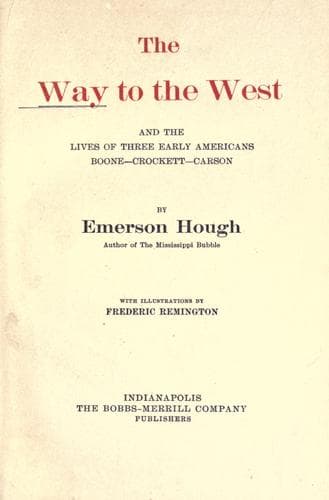
The Way to the West, and the Lives of Three Early Americans: Boone—Crockett—CarsonHough, Emerson
History
The Way to the West, and the Lives of Three Early Americans: Boone—Crockett—Carson
Hough, Emerson
Boone, Daniel, 1734-1820; Carson Kit, 1809-1868; Crockett, Davy, 1786-1836; Mississippi River Valley -- History; West (U.S.) -- History
In general it may be determined that, with some feeling but without much
ado, Crockett said farewell to his wife and family. He had no longer
heart for bear hunting. He wished a wider field of life. His journey was
down the Mississippi and up the Arkansas River to Little Rock. There he
encountered many hail-fellows-well-met, and had several experiences,
which are set forth at length in his autobiography. He journeyed then
horseback to Fulton, descended the Red River to Natchitoches and thence
made his way westward across Texas.
The so-called autobiography of Crockett describes two or three strange
characters: the “Bee Hunter,” who might have been the hero of an English
melodrama of the time; “Thimblerig,” the sharper whom Crockett reforms
and leads on to die a hero’s death; the “Pirate,” who dies in front of
the Alamo gate; and so on. There is something strangely unreal in much
of this. It does not ring true. Yet we are further told that Crockett
crossed the Sabine, that he met the Comanches, that he saw for the first
time the tremendous herds of buffalo, that he encountered bands of wild
horses, that he saw much wild game, and in a knife fight killed a
panther. The feeling is irresistible that many of these pictures are
made to order.
At last, however, without much ado and without any adequate explanation
of Crockett’s real motives, we find him inside the gates of the San
Antonio barracks, one of that little party whose heroic death was to set
the whole American nation a-throb, first with vengeful fire, and then
with a passionate love and admiration.
The situation was thus: Travis in San Antonio, practically hemmed in at
the adobe building known as the Alamo; Fannin at Goliad, with other
noble fellows later to fall victims to Mexican treachery; at a distance
Sam Houston, apparently irresolute and non-committal. Austin, Fannin,
Travis, Rush, James Bowie, the Whartons, Archer of Virginia—what a list
of strong names was here, these fighting men, some of whom had come for
politics, some for sport, some for sheer love of danger and adventure.
Of these, Bowie, Crockett, Fannin and Travis might have been declared
opposed to the party of Houston and Austin. Crockett’s authentic letter
bitterly accuses Houston, the leader of the Texans. Houston, mysterious,
vain, enigmatical, as able as he was erratic, might perhaps, had his
followers been less tempestuous and independent, have united them into a
harmonious and powerful whole. He could not, or did not. Hence came the
Alamo fight.
Public-domain text, read in full here on John Shaqi.
Reviews
Reviews
No reviews yet
Be the first to share your thoughts on this work.
Elsewhere in the archive
Join the Discussion
Join the discussion
Sign in to leave a comment or review.
Sign InorCreate an account