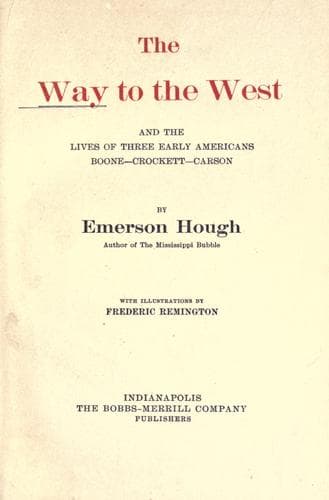
The Way to the West, and the Lives of Three Early Americans: Boone—Crockett—CarsonHough, Emerson
History
The Way to the West, and the Lives of Three Early Americans: Boone—Crockett—Carson
Hough, Emerson
Boone, Daniel, 1734-1820; Carson Kit, 1809-1868; Crockett, Davy, 1786-1836; Mississippi River Valley -- History; West (U.S.) -- History
Of this wild army, half ruffian, half adventurous, most of the men were
poor, although they came in many cases from good families. They had
behind them an undeniable sentiment in favor of the independence of
Texas, and were backed by money raised for that purpose. General Jackson
openly and notoriously favored the annexation of Texas, and perhaps even
of Mexico, and went so far as to suggest a few practical though
unauthorized plans of his own as to how the army might be used to bring
about a conflict and later a pax Jacksonii. Thus we find our hero, Davy
Crockett, once more falling into the plans of his former chief, his
recently victorious antagonist, Old Hickory.
It is possible that Crockett was deceived in his pilgrimage to Texas.
There is more than a suspicion that he was used as a cat’s paw in a
political movement. He says that “Houston is enjoying the support of the
Government, while others are left to do the fighting.” He continues,
“Houston has dealt with us in prevarications.” He calls Houston the
“agent” and Jackson the “manufacturer.” Yet certainly Crockett was
backed by a prevalent and strongly growing sentiment. The records are
too vague and insufficient. We shall never fully understand all these
complications of early and adventurous politics.
Be all these things as they may, Crockett was one of the devoted little
band of a hundred and eighty-three Texans, who in time found themselves
besieged by an army of Mexicans from five thousand to eight thousand
strong. The peons of Santa Anna’s worthless army came on day after day,
the bands playing the Dequelo, which meant “no quarter.” For eleven days
the Texans held the Alamo, in that historic fight whose details are so
generally and so uncertainly known. These one hundred and eighty-three
men killed of the enemy more than one thousand. Worn out by loss of
sleep and continuous muscular exertion, their arms simply grew weary
from much slaying. Their hands could no longer push down the ladders
weighted with the struggling peons goaded forward by the swords of their
officers.
At length an assault was lodged. The swart Mexicans, more in terror than
in exultation, poured across the broken wall. In the hospital lay forty
helpless men, each with his rifle at his side. These, sick and crippled,
broken-bodied, iron-hearted, poured their last volley into their
assailants as they came in. A cannon was discharged down the room and
nearly a score of the crippled and sick were blown to pieces. Outside,
in the open space, the lances of the Mexicans reached farther than the
clubbed rifles or the bitter, biting knives of the stalwart Americans,
now raging in their last tremendous, magnificent and awful Baresark
rage.
Public-domain text, read in full here on John Shaqi.
Reviews
Reviews
No reviews yet
Be the first to share your thoughts on this work.
Elsewhere in the archive
Join the Discussion
Join the discussion
Sign in to leave a comment or review.
Sign InorCreate an account