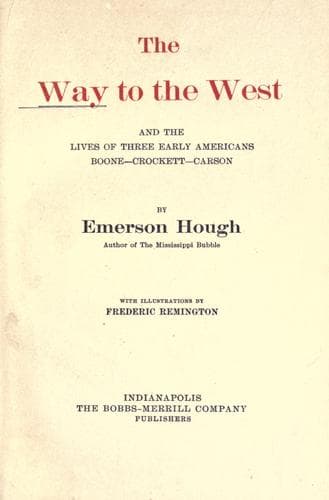
The Way to the West, and the Lives of Three Early Americans: Boone—Crockett—CarsonHough, Emerson
History
The Way to the West, and the Lives of Three Early Americans: Boone—Crockett—Carson
Hough, Emerson
Boone, Daniel, 1734-1820; Carson Kit, 1809-1868; Crockett, Davy, 1786-1836; Mississippi River Valley -- History; West (U.S.) -- History
No one knows the story of the end. Even the number of the victims is
matter of dispute to-day. Some say there were a hundred and eighty-three
defenders, some say a hundred and eighty-six. Some say one woman
escaped; some say two. Some declare that one negro servant got away;
some say two. The state of Texas adopted the “Alamo baby,” but the Alamo
baby did not see Crockett fall. There are different reports. Some state
that there were six Americans left hemmed up against the wall, and that
the Mexican general, Castrillon, called upon them to surrender. They did
so, Crockett being one of the six. Confronting the Mexican commander,
they were treacherously ordered to be shot down. It is said that
Crockett, bowie knife in hand, sprang with all his force for the throat
of the Mexican general, but was cut down or shot down with the others,
“his face even in death wreathed in an expression of contempt and scorn
at such treachery.”
All this is but imagination; and there is all reason to suppose that
there never was any surrender of these six last survivors. The commoner
story is that Crockett fought to the last with his broken rifle, and was
killed against the wall, before him lying the bodies of some twenty
Mexicans. The usual impression is that he killed these twenty Mexicans
himself before he was cut down, but this is perhaps the result of
emotional writing. No one knows how many foes had fallen to his arm. No
one can tell how many Mexicans each of these raging, fighting men
destroyed before he himself went down. Earlier in the siege Crockett
recounts picking off five cannoneers one after the other. He tells how
the Bee Hunter and Thimblerig did their sharpshooting, how the Pirate
died of wounds received in a sortie, how the Bee Hunter—a most unlikely
thing—burst into poesy and song at the hoisting of the Texas flag. Some
of these things have too unreal a sound. There is something not quite
Crockett, though à la Crockett, in the conclusion of Crockett’s
so-called, or rather alleged, diary:
“March 5.—Pop, pop, pop! Bom, bom, bom! throughout the day. No time for
memorandums now. Go ahead. Liberty and independence forever!”
These are the last recorded words of dear Davy Crockett. It is probable
in the extreme that he never wrote them. It is unlikely to an equal
degree that, in all the turmoil of the Alamo fight, he could
deliberately have kept a diary, or that it could have been preserved
after all the horrible details of that bloody and disastrous conflict.
As to the end of Davy Crockett, there is and has been no living human
being who could speak with absolute accuracy and authenticity. Bloody
San Jacinto, the field where the cry “Remember the Alamo!” was the
watchword of a dire and just revenge, left but few Mexican eye-witnesses
of the Alamo.
Public-domain text, read in full here on John Shaqi.
Reviews
Reviews
No reviews yet
Be the first to share your thoughts on this work.
Elsewhere in the archive
Join the Discussion
Join the discussion
Sign in to leave a comment or review.
Sign InorCreate an account