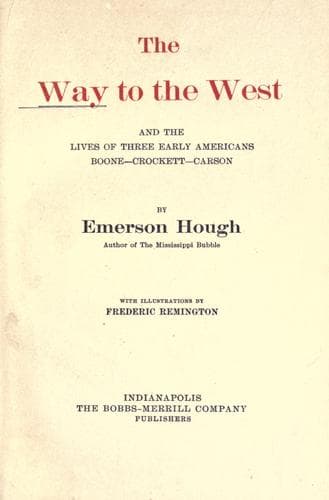
The Way to the West, and the Lives of Three Early Americans: Boone—Crockett—CarsonHough, Emerson
History
The Way to the West, and the Lives of Three Early Americans: Boone—Crockett—Carson
Hough, Emerson
Boone, Daniel, 1734-1820; Carson Kit, 1809-1868; Crockett, Davy, 1786-1836; Mississippi River Valley -- History; West (U.S.) -- History
Be that as it may, we know that Davy Crockett died fighting, that he
died with his face to the enemy, like the brave man that he was,
undaunted, unafraid. No politics now, no statesmanship, no little
ambitions now for Davy Crockett. He was once more the child of the
wilderness, stark, savage, exultant, dreadful, one more of those Titanic
characters that swept away a weaker population, beat down all
opposition, conquered the American wilderness and made way for an
American civilization.
* * * * *
The study of Crockett’s life shows us an America yet loose and
scattered, not knit together into a national whole; and the political
problems of that day were still those arising from geography. Backwoods
Davy was after all not so poor a thinker, nor so far from getting to the
marrow of things. After his visit to the North, and his reconciliation
to the doctrines of a protective tariff, he makes one comment which,
while it may not settle political argument, ought to teach a national
courtesy and a human tolerance on both sides in any national difference.
“If Southerners would visit the North,” he says, “it would give
different ideas to them who have been deluded and spoken in strong terms
of dissolving the Union.” A trifle ungrammatical this, perhaps, but
startling reading, when one remembers that it was recorded in 1834.
Again we find our independent thinker discussing freely the questions of
transportation, which were then and always have been so important in
this country. He was opposed to Jackson in the first place because
Jackson “vetoed the bill for the Maysville road.” He was opposed to Van
Buren because he “voted against the continuance of the national road
through Ohio, Indiana and Illinois, and against appropriations for its
preservation.” He opposed Van Buren further because he “voted in favor
of toll gates on the national road, demanding a tribute from the West
for the right to pass on her own highways, constructed out of her own
money,—a thing never heard of before.”
Crockett’s changes of residence, ever drifting farther to the westward
in his native state, and his final long pilgrimage to the Southwest,
where he certainly, though his autobiography does not so state, visited
different parts of Texas and the Indian nations, is index of the
tendency of the times. The West of that day is the South of to-day.
Thus, a writer of 1834 states, “The West is settled by representatives
from every country, but it is very largely indebted for its inhabitants
to Virginia, Georgia and the two Carolinas.” History and our census maps
show us that the day of the upper West was yet to come. Boone and his
like had led across the Appalachians. Crockett and his like had crossed
the Mississippi. The march toward the Rockies was now steadily and
determinedly begun, under what difficulties and with what results we
shall presently observe.
-----
Footnote 14:
Public-domain text, read in full here on John Shaqi.
Reviews
Reviews
No reviews yet
Be the first to share your thoughts on this work.
Elsewhere in the archive
Join the Discussion
Join the discussion
Sign in to leave a comment or review.
Sign InorCreate an account