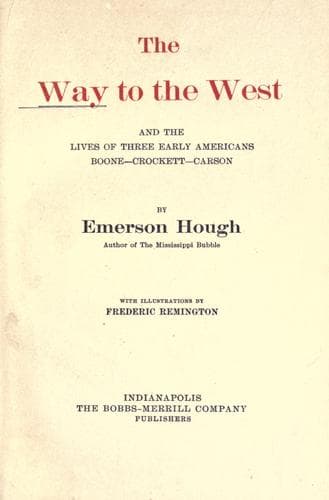
The Way to the West, and the Lives of Three Early Americans: Boone—Crockett—CarsonHough, Emerson
History
The Way to the West, and the Lives of Three Early Americans: Boone—Crockett—Carson
Hough, Emerson
Boone, Daniel, 1734-1820; Carson Kit, 1809-1868; Crockett, Davy, 1786-1836; Mississippi River Valley -- History; West (U.S.) -- History
The black bears which fed on the corpses left on the field of
Braddock’s Defeat became for a time bold and somewhat fearless of man.
Footnote 15:
These stories are not to be doubted, and are not especially wonderful.
The writer has often hunted in Mississippi with a planter, Colonel R.
E. Bobo, who more than equalled all of Crockett’s records. In one
year, soon after his first arrival in Coahoma County, Mississippi,
Colonel Bobo killed two hundred and six bears. The writer was present
when ten bears were killed in eight days.
CHAPTER II
AGAINST THE WATERS[16]
In 1810 the Western frontier of the United States slanted like the roof
of a house from Maine to Louisiana. The center of population was almost
exactly on the site of the city of Washington. The West was a distinct
section, and it was a section that had begun to develop an aristocracy.
We still wore linsey-woolsey in Kentucky; still pounded our corn in a
hollow stump in Ohio; still killed our Indians with the ancient weapon
of our fathers; still took our produce to New Orleans in flat-boats;
still were primitive in many ways.
None the less we had among us an aristocrat, a man who classified
himself as better than his fellow men. There had been born that early
captain of transportation, the keel-boatman, the man that could go
up-stream. The latter had for the stationary or semi-stationary man a
vast and genuine contempt, as nomad man has ever had for the man of
anchored habit. There was warrant for this feeling of superiority, for
the keel-boat epoch was a great one in American history. Had this clumsy
craft never been supplanted by the steamboat, its victories would have
been of greater value to America than all the triumphs she ever won on
the seas.
As for the keel-boatmen themselves, they were a hardy, wild, and
reckless breed. They spent their days in the blazing sun, their heads
drooping over the setting-pole, their feet steadily trudging the
walking-boards of their great vessels from morning until night and day
after day. A wild life, a merry one, and a brief, was that lived by this
peculiar class of men, who made characters for one of the vivid chapters
in the tale of the early West.
The men of the West had solved in some rude way the problem of getting
up-stream, though still they clung to the highways of nature, the
water-courses. The men of the ax and rifle had once more broken over the
ultimate barriers assigned to them by the men of book and gown. That
mysterious land beyond the Mississippi was even then receiving more and
more of that adventurous population that the statesmen of the Louisiana
Purchase feared would leave the East and never would return.
Public-domain text, read in full here on John Shaqi.
Reviews
Reviews
No reviews yet
Be the first to share your thoughts on this work.
Elsewhere in the archive
Join the Discussion
Join the discussion
Sign in to leave a comment or review.
Sign InorCreate an account