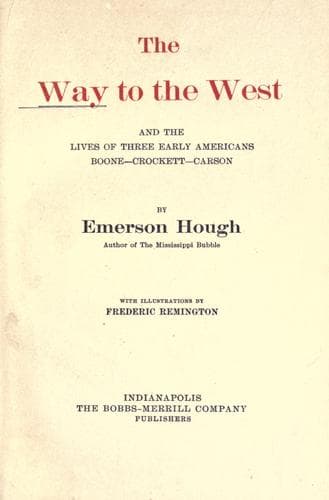
The Way to the West, and the Lives of Three Early Americans: Boone—Crockett—CarsonHough, Emerson
History
The Way to the West, and the Lives of Three Early Americans: Boone—Crockett—Carson
Hough, Emerson
Boone, Daniel, 1734-1820; Carson Kit, 1809-1868; Crockett, Davy, 1786-1836; Mississippi River Valley -- History; West (U.S.) -- History
The fur traders of St. Louis had found a way to reach the Rockies. The
adventurous West was once more blazing a trail for the commercial and
industrial West to follow. This was the second outward setting of the
tide of west-bound travel. We had used up all our down-stream
transportation, and we had taken over, and were beginning to use, all
the trails that led into the West, all the old French trails, the old
Spanish trails, the trails that led out with the sun. No more war
parties now from the Great Lakes to the Ohio, from the Great Lakes to
the Mississippi. This was our country. We held the roads.
But now there were happening yet other strange and startling things. In
1806, at Pittsburg, some persons built the first steamboat ever seen on
the Ohio River. Its first trip was the occasion of much rejoicing, and
was celebrated with fervor, which, however, must have received a certain
dampening by the outcome of the experiment. The boat, crowded with
excited spectators, ran very handsomely down-stream, but when it essayed
to return the current proved too strong, and only setting-poles and
rowboats saved the day. This, then, was the precursor of an aristocracy
in transportation before which even the haughty keel-boatmen were
obliged to abase themselves. In 1811 the steamer New Orleans was built
at Pittsburg, and following the guidance of “Mr. Roosevelt of New York,”
who had previously investigated the matter, successfully ran the
riverway to New Orleans.[17] More than that, she proved able to return
up-stream.[18] What fate then was left for the keel-boats?
In 1819 a steamboat had appeared as far west on the Great Lakes as
Mackinaw. In 1826 a steamboat reached Lake Michigan. In 1828 the first
steamboat of the American Fur Company mastered the turbid flood of the
Missouri, and ascended that stream as far as the Great Falls.[19] In
1832 a steamboat arrived at the city of Chicago. The West was now
becoming very much a country of itself.
The curious fact continued to be fact—that it was the South that was to
open, the North and the East that were to occupy. Of the two essential
tools, the Southern man might have left at home his ax, the Northern man
his rifle. But it was as yet no time for a North or a South. The
Northerners and the Southerners both became Westerners, and if the ax
followed the rifle, the plow as swiftly came behind the ax.
Thanks to the man that could go up-stream, corn was no longer worth one
hundred and sixty-five dollars a bushel anywhere in America. Corn was
worth fifty cents a bushel, and calico was worth fifty cents a yard, at
the city of Kaskaskia, in the heart of the Mississippi valley.
Kaskaskia, the ancient, was queen of the down-stream trade in her day.
She was important enough to command a visit from General Lafayette,
early in this century; and the governor of Illinois addressed the
distinguished visitor with an oratory not without interest, since it was
alike full of bombast, of error, of truth, and of prophecy:
Public-domain text, read in full here on John Shaqi.
Reviews
Reviews
No reviews yet
Be the first to share your thoughts on this work.
Elsewhere in the archive
Join the Discussion
Join the discussion
Sign in to leave a comment or review.
Sign InorCreate an account