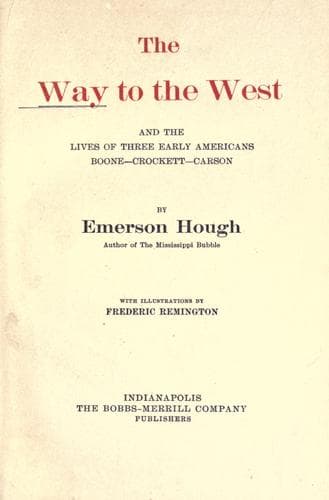
The Way to the West, and the Lives of Three Early Americans: Boone—Crockett—CarsonHough, Emerson
History
The Way to the West, and the Lives of Three Early Americans: Boone—Crockett—Carson
Hough, Emerson
Boone, Daniel, 1734-1820; Carson Kit, 1809-1868; Crockett, Davy, 1786-1836; Mississippi River Valley -- History; West (U.S.) -- History
“Sir, when the waters of the Mississippi, generations hence, are
traversed by carriers of commerce from all parts of the world; when
there shall live west of the Father of Waters a people greater in
numbers than the present population of the United States; when, sir, the
power of England, always malevolent, shall have waned to nothing, and
the eagles and stars of our national arms be recognized and honored in
all parts of the globe; when the old men and the children of to-day
shall have been gathered to their fathers, and their graves have been
obliterated from the face of the earth, Kaskaskia will still remember
and honor your name. Sir, as the commercial queen of the West, she
welcomes you to a place within her portals. So long as Kaskaskia exists,
your name and praises shall be sung by her.”
To-day Kaskaskia is forgotten. The conditions that produced her have
long since disappeared. The waters, in pity, have literally washed her
away and buried her far in the southern sea. Yet Kaskaskia serves
admirably as a measuring point for the West of that day. She stood at
the edge of civilization on the one hand, of barbarism on the other.
Beyond her lay a land as unknown as the surface of the moon, a land that
offered alike temptation and promise. Calico was worth fifty cents a
yard at Kaskaskia; it was worth three dollars a yard in Santa Fé. A
beaver skin was worth three dollars in New York; it was worth fifty
cents at the head of the Missouri.
There you have the problems of the men of 1810, and that, in a nutshell,
is the West of 1810, 1820, 1830. The problem was then, as now, how to
transport a finished product into a new country, a raw product back into
an old country, and a population between the two countries. There sprang
up then, in this second era of American transportation, that mighty
commerce of the prairies, which, carried on under the name of trade,
furnished one of the boldest commercial romances of the earth. Fostered
by merchants, it was captained and carried on by heroes, and was
dependent upon a daily heroism such as commerce has never seen anywhere
except in the American West. The Kit Carsons now took the place of the
Simon Kentons, the Bill Williamses, of the Daniel Boones. The Western
scout, the trapper, the hunter, wild and solitary figures, took
prominent place on the nation’s canvas.
This Western commerce, the wagon freighting, steamboating, and packing,
of the first half of this century, was to run in three great channels,
each distinct from the other. First there was the fur trade, whose birth
was in the North. Next there was the trade of mercantile ventures to the
far Southwest. Lastly there was to grow up the freighting trade to the
mining regions of the West. The cattle-growing, farming, or commercial
West of to-day was still a thing undreamed.
Public-domain text, read in full here on John Shaqi.
Reviews
Reviews
No reviews yet
Be the first to share your thoughts on this work.
Elsewhere in the archive
Join the Discussion
Join the discussion
Sign in to leave a comment or review.
Sign InorCreate an account