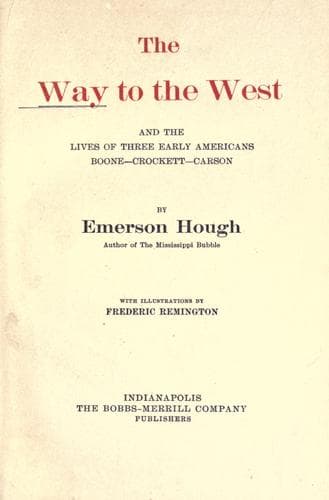
The Way to the West, and the Lives of Three Early Americans: Boone—Crockett—CarsonHough, Emerson
History
The Way to the West, and the Lives of Three Early Americans: Boone—Crockett—Carson
Hough, Emerson
Boone, Daniel, 1734-1820; Carson Kit, 1809-1868; Crockett, Davy, 1786-1836; Mississippi River Valley -- History; West (U.S.) -- History
In every one of these three great lines of activity we may still note
what we may call the curiously individual quality of the West. The
conditions of life, of trade, of any endurance on the soil, made heavy
demands upon the physical man. There must, above all things, be
strength, hardihood, courage. There were great companies in commerce, it
is true, but there were no great corporations to safeguard the persons
of those transported. Each man must “take care of himself,” as the
peculiar and significant phrase went. “Good-by; take care of yourself,”
was the last word for the man departing to the West.[20]
The strong legs of himself and his horse, the strong arms of himself and
his fellow laborers, these must furnish his transportation. The muscles
tried and proved, the mind calm amid peril, the heart unwearied by
reverses or hardships—these were the items of the capital, universal
and indispensable, of the West. We may trace here the development of a
type as surely as we may by reading the storied rocks of geology. This
time of boat and horse, of pack and cordelle and travois, of strenuous
personal effort, of individual initiative, left its imprint forever and
indelibly on the character of the American, and made him what he is
to-day among the nations of the globe.
There was still a West when Kaskaskia was queen. Major Long’s expedition
up the Platte brought back the “important fact” that the “whole division
of North America drained by the Missouri and the Platte, and their
tributaries between the meridians of the mouth of the Platte and the
Rockies, is almost entirely unfit for cultivation, and therefore
uninhabitable for an agricultural people.” There are many thousands of
farmers to-day who can not quite agree with Major Long’s dictum, but in
that day the dictum was accepted carelessly or eagerly. No one west of
the Mississippi yet cared for farms. There were swifter ways to wealth
than farming, and the wild men of the West of that day had only scorn
and distrust for the whole theory of agriculture.
“As soon as you thrust the plow into the earth,” said one adventurer who
had left the East for the wilder lands of the West, “it teems with worms
and useless weeds. Agriculture increases population to an unnatural
extent.” For such men there was still a vast world without weeds, where
the soil was virgin, where one might be uncrowded by the touch of
home-building man. Let the farmers have Ohio and Kentucky; there was
still a West.
Public-domain text, read in full here on John Shaqi.
Reviews
Reviews
No reviews yet
Be the first to share your thoughts on this work.
Elsewhere in the archive
Join the Discussion
Join the discussion
Sign in to leave a comment or review.
Sign InorCreate an account