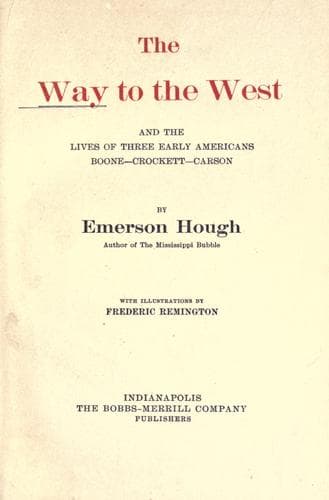
The Way to the West, and the Lives of Three Early Americans: Boone—Crockett—CarsonHough, Emerson
History
The Way to the West, and the Lives of Three Early Americans: Boone—Crockett—Carson
Hough, Emerson
Boone, Daniel, 1734-1820; Carson Kit, 1809-1868; Crockett, Davy, 1786-1836; Mississippi River Valley -- History; West (U.S.) -- History
There was, in the first place, then, the West of the fur trade, the
trade that had come down through so many vicissitudes, legacy of Louis
the Grand Monarch and his covetous intriguers. For generations the
coureurs du bois, wild peddlers of the woods, had traced the ultimate
waterways of the far Northwest, sometimes absent for one, two, or more
years from the place they loosely called home, sometimes never returning
at all from the savagery that offered so great a fascination, often too
strong even for men reared in the lap of luxury and refinement.
Steam was but an infant, after all, in spite of the little steamboat
triumphs of the day. The waters offered roadway for the steamboats, and
water transportation by steam was much less expensive than
transportation by railway; but the head of navigation by steamboats was
only the point of departure of a wilder and cruder transportation.
Beyond the natural reach of the canot du Nord, the lesser craft of the
natives, the smaller birch-barks, took up the trail, and passed even
farther up into the unknown countries; and beyond the head of the
ultimate thread of the waters the pack-horse, or the travois and the
dog, took up the burden of the day, until the trails were lost in the
forest, and the traveler carried his pack on his own back.[21]
It is a curious fact, and one perhaps not commonly known, that the
Indian sign of the “cutthroat” (the forefinger drawn across the throat),
which is the universal name for “Sioux” among all other American tribes,
is, in all likelihood, a misnomer. The Sioux were dog Indians of old,
before they got horses from the West, and they worked the dog as a draft
animal, with a collar about the neck, just as it is now worked over much
of the sub-arctic country. The sign of the two fingers across the neck
once indicated “dog” as plainly as the single finger across the neck now
signifies “cutthroat.” Not only did the native and early white wanderers
of the wilderness use the dog as a draft animal, but they packed him as
they later packed the horse in the wagonless lands of the West.
This fact is still quite within the memory or practice of man. A dog
could draw more on a travois, or pole-frame, than he could carry on his
back. It was not unusual to see a great copper kettle lashed to the
poles of a travois drawn by a dog, and in the kettle piled
indiscriminately moccasins, babies, puppies, and other loose personal
property. Hitched to the proper sledge, six dogs could draw a thousand
pounds over the snow. Thus ran the earliest stagecoach in the West.
Public-domain text, read in full here on John Shaqi.
Reviews
Reviews
No reviews yet
Be the first to share your thoughts on this work.
Elsewhere in the archive
Join the Discussion
Join the discussion
Sign in to leave a comment or review.
Sign InorCreate an account