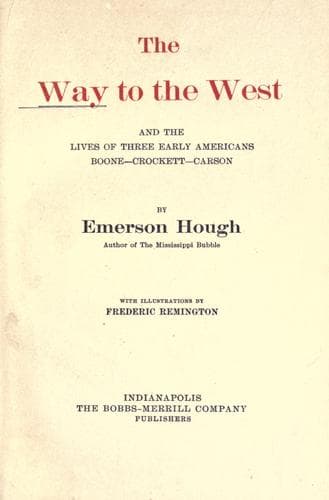
The Way to the West, and the Lives of Three Early Americans: Boone—Crockett—CarsonHough, Emerson
History
The Way to the West, and the Lives of Three Early Americans: Boone—Crockett—Carson
Hough, Emerson
Boone, Daniel, 1734-1820; Carson Kit, 1809-1868; Crockett, Davy, 1786-1836; Mississippi River Valley -- History; West (U.S.) -- History
The great canoe, the travois, and the sledge were inventions of the
early French fur trade, but we used them as we needed them when the fur
country became our own. France ceded her trading posts to England in
1763, and England transferred them to us in 1796. The great Northwest
Company had by 1783 extended its posts all along our Northern border,
not being too particular about crossing the line; but by 1812 we had
made our authority felt, and by 1816 had passed a law excluding
foreigners from our fur trade. The old Northwest Company handed over to
the younger American Fur Company all the posts found to be within our
marches. We heard, for the time, of the Pacific Fur Company, the Rocky
Mountain Fur Company, the Missouri Fur Company, of the “free trappers”
and “free traders” of the West.
It matters not what form or name that trade assumed. The important fact
is that we now, by means of this wild commerce, began to hear of such
lands as Oregon, of that region now known as Montana, of a thousand
remote and unmapped localities, which might ultimately prove
inhabitable. Summer or winter, over all these new lands the wild new
travel of the West went on, and after fashions it determined for itself.
Thus, in the country of the Missouri, the left fork of our great
American waterway, there was no birch-bark for the making of the canot
du Nord. Hence the keel-boat, the setting pole and the sweep, the sail
and the tracking line. Yet the great craft, like the Northern birch-bark
ship, must at last reach a land of waterways too small for its bulk. The
Montana adventurers had not birch-bark, but they had the buffalo. They
made “bull boats” out of the sun-dried hides, and these rude craft
served to carry many a million dollars’ worth of furs over gaps that
would have seemed full long to a walking man.
The outlying posts[22] at the head of the far-off streams received their
supplies from the annual caravan of keel-boats, or the later great
Mackinaw boats, square-sterned craft fifty feet long, of twelve-foot
beam, of four-foot freeboard, and a carrying capacity of fourteen
tons.[23] Each of these boats required a crew of twelve men, and it took
six months of the hardest labor towing, tracking, poling, and rowing to
get the clumsy craft from St. Louis to such a spot as old Fort Benton.
The run downstream required only about thirty days, and it was commonly
believed that the square stern of the Mackinaw caused it to run faster
than the current in taking the rapids of the Missouri.
Public-domain text, read in full here on John Shaqi.
Reviews
Reviews
No reviews yet
Be the first to share your thoughts on this work.
Elsewhere in the archive
Join the Discussion
Join the discussion
Sign in to leave a comment or review.
Sign InorCreate an account