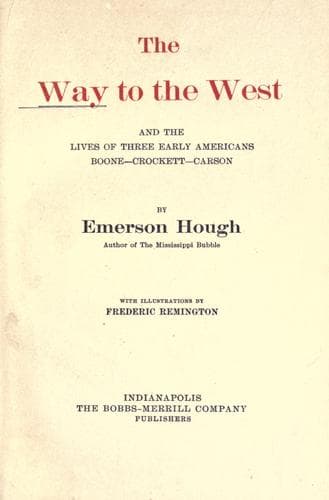
The Way to the West, and the Lives of Three Early Americans: Boone—Crockett—CarsonHough, Emerson
History
The Way to the West, and the Lives of Three Early Americans: Boone—Crockett—Carson
Hough, Emerson
Boone, Daniel, 1734-1820; Carson Kit, 1809-1868; Crockett, Davy, 1786-1836; Mississippi River Valley -- History; West (U.S.) -- History
The labor of this primitive transportation, this wading for hundreds of
miles each spring against an icy torrent, was not work for children. It
was not children that this wild trade begot, but men. The Titanic region
demanded Titanic methods. It made its own laws and customs, struck out
for itself new methods. The world beyond never asked the world behind
what or how to do. This vast, rude land asked no other country how to
perform the tasks that lay before it. Of the wildness and rudeness of
this new world there could be no question, but its savagery was met by a
savage determination more fearless and indomitable than its own.
The mountain trapper, the prairie freighter and trader, the California
miner were great men, tremendous men, fit successors of those that
fought their way across the Alleghanies. The fur trade was practically
over by 1834, and the Santa Fé trade lasted, roughly speaking, only
about twenty years, being practically terminated in 1843 by the edict of
Santa Anna. These difficulties in our Western commerce all came to an
end with the Mexican War, and with the second and third great additions
to our Western territory, which gave us the region on the south as well
as the north, from ocean to ocean.
This time was one of great activity in all the West, and the restless
population that had gained a taste of the adventurous life of that
region was soon to have yet greater opportunities. The discovery of gold
in California unsettled not only all the West, but all America, and
hastened immeasurably the development of the West, not merely as to the
Pacific coast, but also in regard to the mountain regions between the
great plains and the coast.
The turbulent population of the mines spread from California into every
accessible portion of the Rockies. The trapper and hunter of the
remotest range found that he had a companion in the wilderness, the
prospector, as hardy as himself, and animated by a feverish energy that
rendered him even more determined and unconquerable than himself. Love
of excitement and change invited the trapper to the mountains. It was
love of gain that drove the prospector thither. Commercial man was to do
in a short time what the adventurer would never have done. California,
Oregon, Idaho, Montana,—how swiftly, when we come to counting decades,
these names followed upon those of Kentucky, Tennessee, and Ohio!
In the new demands for locomotion and transportation, which now arose
from these new armies of moving men, the best thinkers of the country
could for a long time suggest nothing better than the sea and the rivers
as the great highways. Steamboats ran regularly on every Western river
where such navigation was possible. Yet at the head of the waters there
still existed, and in greater degree than ever before, long gaps between
the abodes of the mountain population and their bases of supplies. The
demand, moreover, was for transportation of heavy goods.
Public-domain text, read in full here on John Shaqi.
Reviews
Reviews
No reviews yet
Be the first to share your thoughts on this work.
Elsewhere in the archive
Join the Discussion
Join the discussion
Sign in to leave a comment or review.
Sign InorCreate an account