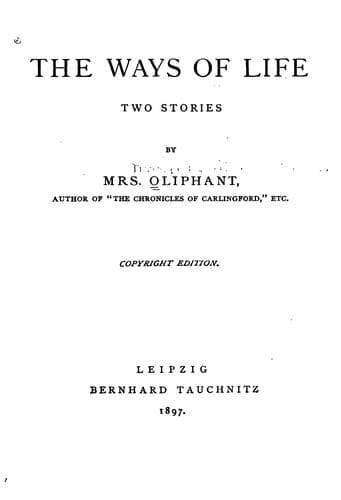
The Ways of Life: Two StoriesOliphant, Mrs. (Margaret)
General
The Ways of Life: Two Stories
Oliphant, Mrs. (Margaret)
Fiction
pulling to pieces a recent exhibition of the works of a Royal
Academician. “You would think you had got among half a dozen different
sorts of people dressed for private theatricals,” said one of the
youths. “Old models got up as Shakespearian kings, and that sort of
thing. _You_ know, Mrs. Sandford; conventional groups trying to look as
if they were historical.”
“I remember Mr. White’s pictures very well,” said Mrs. Sandford. “I used
to think them beautiful. We all rushed to see what he had in the
exhibition, upon the private view day, when I did not know so much about
it as I do now.”
“Ah, yes; before you knew so much about it,” said the art authority.
“You would think very differently to-day.”
“The whole school is like that,” said another. “Historical painting is
gone out like historical novel-writing. The public is tired of costume.
Life is too short for that sort of thing. We want a far more profound
knowledge of the human figure and beauty in the abstract----”
“Stuff!” said Harry; “the British public doesn’t want your nudities,
whatever you may think.”
“The British public likes babies, and sick girls getting well, and
beautiful young gentlemen saying eternal adieux to lovely young ladies,”
said one of the girls.
“To be sure, that sort of thing always goes on; but everybody must feel
that in cultured circles there is a far greater sense of the beauty of
colour for itself and art for art than in those ridiculous old days when
the subject was everything----”
“You confuse me with your new lights,” said Mrs. Sandford. “I always did
think there was a great deal in a good subject.”
“My dear Mrs. Sandford!” cried one of the young men, laughing; while
another added, with the solemnity of his kind--
“People really did think so at one time. It was a genuine belief so long
as it lasted. I am not one of those who laugh at faith so _naïf_.
Whatever is true even for a time has a right to be respected,” said
this profound young man.
Mr. Sandford came in at this point, having paused a little to enjoy the
fun, as he said to himself. It was wonderful to hear how they
chattered--these babes. “I am glad to hear that you are all so tolerant
of the old fogeys,” he said, with a laugh as he showed himself. And one
at least of the young men had the good taste to jump up as if he were
ashamed of himself, and to take his legs out of the way.
“I suppose that’s the new creed that those fellows were giving forth,”
he said to Jack, when the other young men were gone.
“Oh, I don’t know, sir,” said Jack, with an embarrassed laugh. “We all
of us say our say.”
“But that is the say of most of you, I suppose,” said his father.
“Well, sir, I suppose every generation has its own standard. ‘The old
order changeth,’ don’t you know--in art as well as in other things.”
Public-domain text, read in full here on John Shaqi.
Reviews
Reviews
No reviews yet
Be the first to share your thoughts on this work.
Join the Discussion
Join the discussion
Sign in to leave a comment or review.
Sign InorCreate an account